

Tapper Lift for Meta
What Meta Lift does
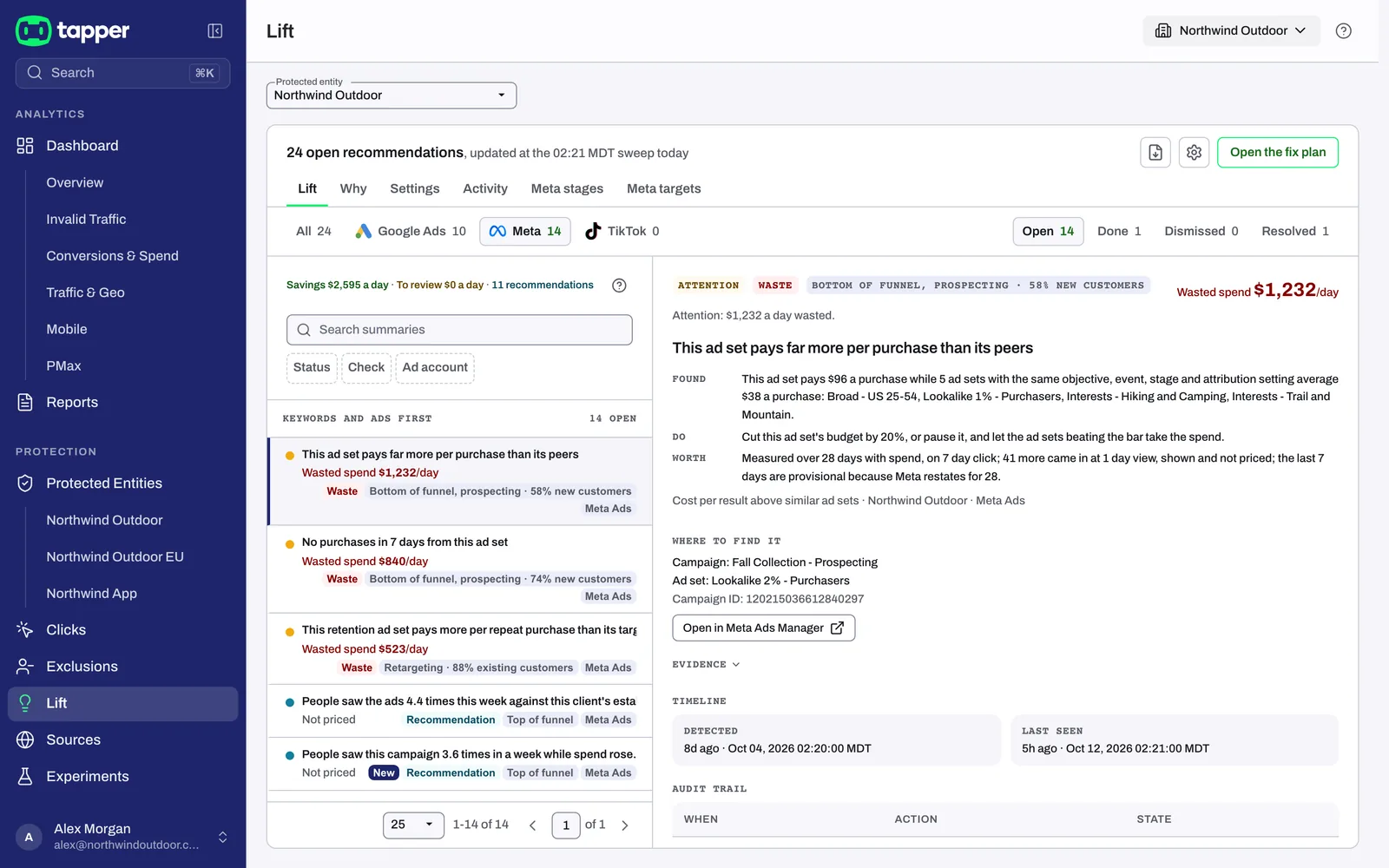
Meta Lift reviews your Meta ad accounts (Facebook and Instagram) every day and shows, in plain words, where money is spent without results, where settings work against you and where your ads are wearing out. Each finding is a card that says what was found and what to do, with the evidence underneath.
Meta Lift judges each ad set by what it is for: an awareness ad set on reach and frequency, a traffic or lead ad set on what happens after the click, a sales ad set on what each result costs. It never compares an ad with the ads beside it, and never recommends spending more. It reads your account through Meta's own reporting, with no tag on your website.
How fixes are made. Meta Lift recommends; you decide. Make the change in Meta Ads Manager (each card links to the exact campaign, ad set or ad), then mark the card as done. Tapper does not change anything in your Meta account.
Funnel stages
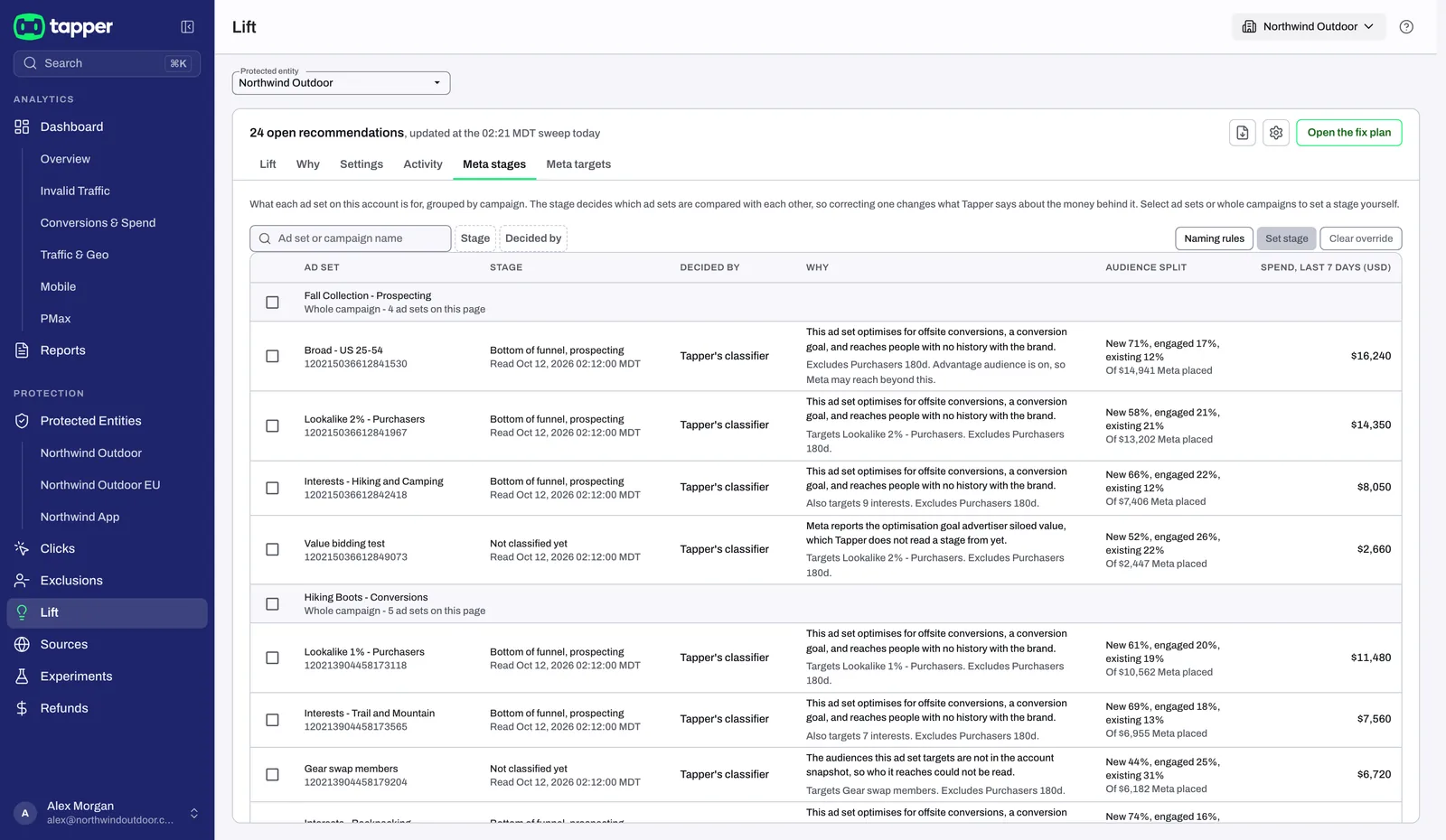
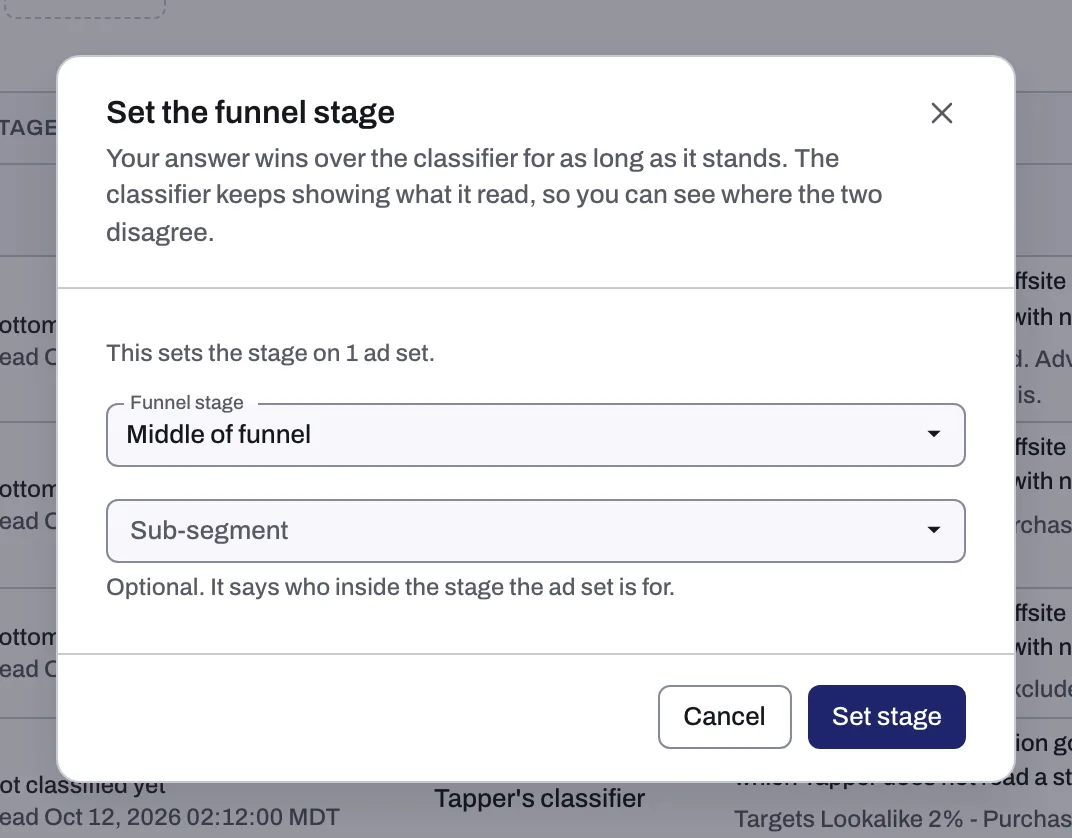
Before anything is judged, every ad set gets a funnel stage from its optimization goal and audiences: Top of funnel (awareness, reach, video views, brand engagement), Middle of funnel (traffic, landing page views, leads, messages, and ads shown again to people who watched or engaged), Bottom of funnel (sales and other conversions, catalog ads, and ads shown to people who visited your site or app) or Retargeting (only your customer lists or past buyers). An ad set Lift cannot place reads Not classified yet, and only the checks for every stage run on it until you set its stage.
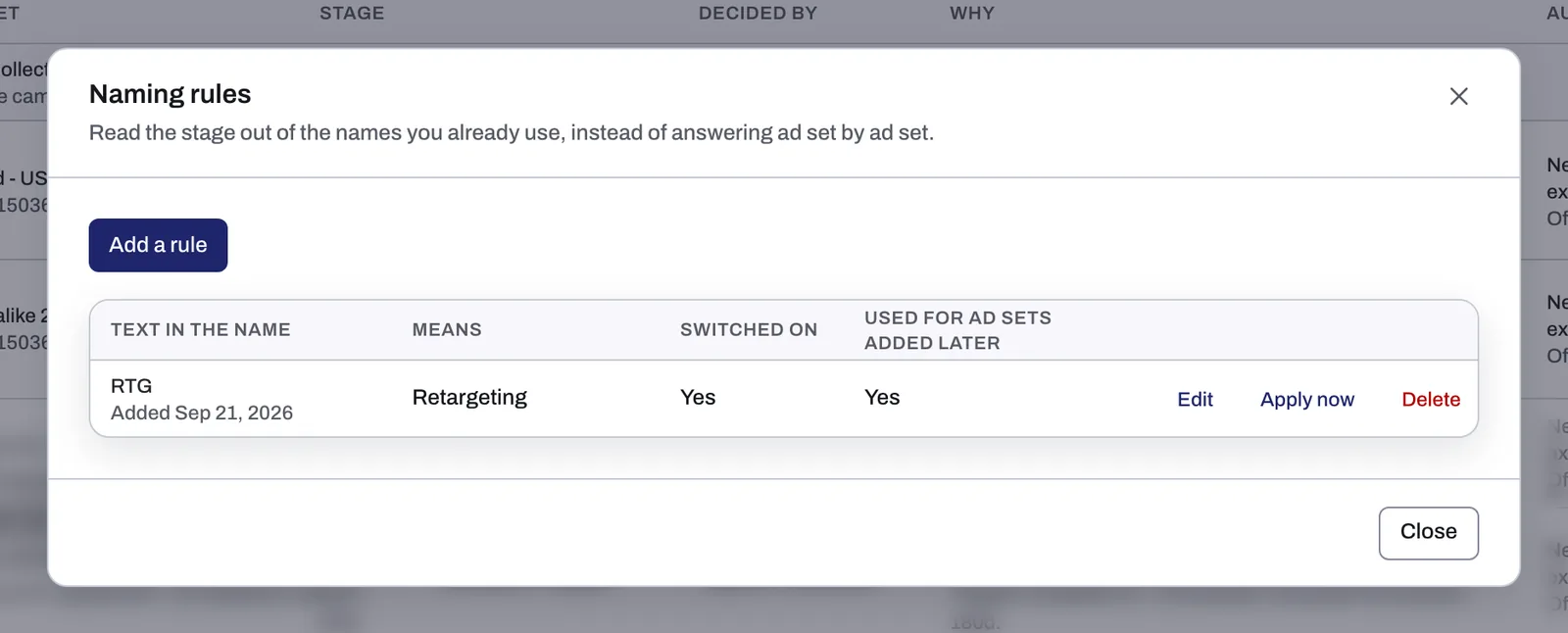
Stage map, a tab of the Meta area of Business details, lists every ad set with its stage, how it was decided, its last 7 days of spend and where that spend went. There you set a stage on an ad set or a whole campaign (your answer wins while it stands), or add a naming rule so names such as "PROSP" set the stage, for later ad sets too. See Check the funnel stage Lift gives each Meta ad set.
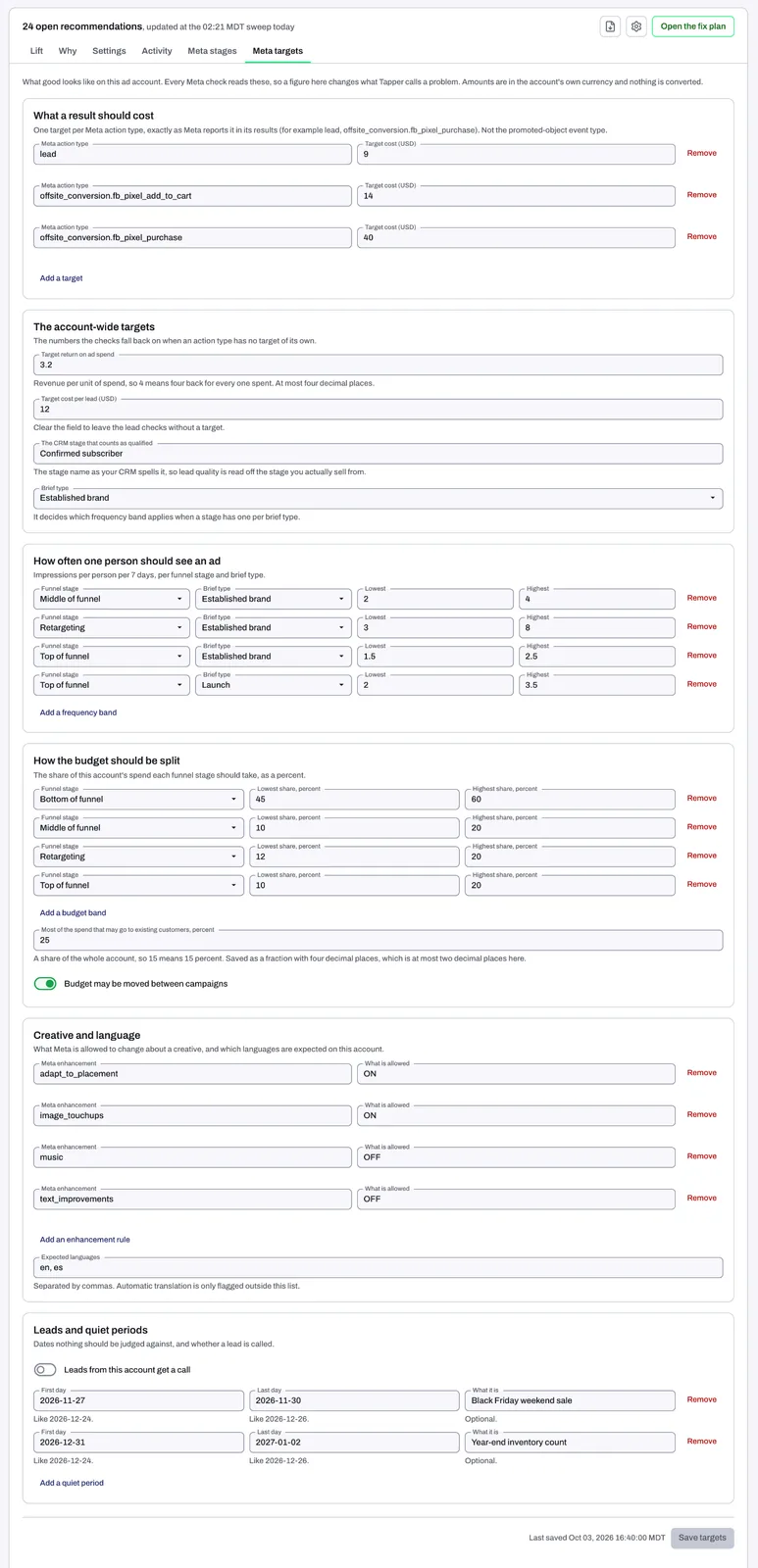
Your targets
Workspace targets, a tab of the Meta area of Business details, tells Lift what good looks like for each Meta ad account: what a result should cost, how often one person should see an ad, how the budget should split across funnel stages, creative and language rules, and leads and quiet periods. Automatic translation is only flagged for languages outside your expected list. Until you save targets, checks compare your ad sets with similar ad sets on the same account; saved targets rescore the cards at the next daily review. See Set your Meta targets.
What Meta Lift looks for
Cost and results
- No results after real spend
- Cost per result above similar ad sets
- Cost per lead above similar ad sets
- Return on ad spend under target over 3 days and 7 days
- Bid cap or ROAS goal looser than the target
- Retention ad set missing its target
Customers and audiences
- Prospecting spend going to existing customers
- Audience segments not set up in Ads Manager
- Retargeting ad set spending outside its warm audience
- Warm audience seeing the ads too often as clicks fall
After the click
- Buying link clicks where landing page views are measured
- Landing page view rate below its own baseline
- Ad set losing people at one step
- Clicks arriving with no landing page views recorded
Reach and frequency
- People seeing the ads more often than planned
- Weekly frequency too low to build recall
- Extra spend buying repeat views, not new people
- Cost per person reached rising while CPM holds
- Low visibility placement absorbing the reach
Creative
- Ad wearing out
- Hook rate falling against the ad's first week
Structure and placements
- Campaign funds more than one funnel stage
- Funnel stage getting more or less budget than planned
- Overlapping ad sets worth merging
- Ad set learning limited while it spends
- Much of the account's spend is learning limited
- Ad set still in learning after a week
- Placement costing more than the rest of the ad set
- Legacy Advantage+ shopping campaign Meta will pause
Account health
- Spending limit or balance close to stopping delivery
- Ad account disabled or flagged by Meta
- Ad sets in one campaign use different attribution settings
- Breakdown reporting not switched on for the account
How Meta Lift judges
Like with like. An ad set is compared only with ad sets on the same account with the same objective, optimization event, funnel stage, attribution setting, country and language. An ad is judged only against its own history.
Results as Meta counts them. Results are read on the 7-day click attribution window. One-day view results show on the card but do not price it.
Quiet periods are left alone. Lift does not advise changes to an ad set still in Meta's learning phase, an ad set with under a week of spend, or a campaign with no spend in the last 3 days. The learning checks are the exception: they never ask you to change the learning ad set, only the others around it.
Never spend more. Meta Lift never recommends raising a budget or loosening a cap. When it suggests moving budget, the account's total stays the same.
How to read a card
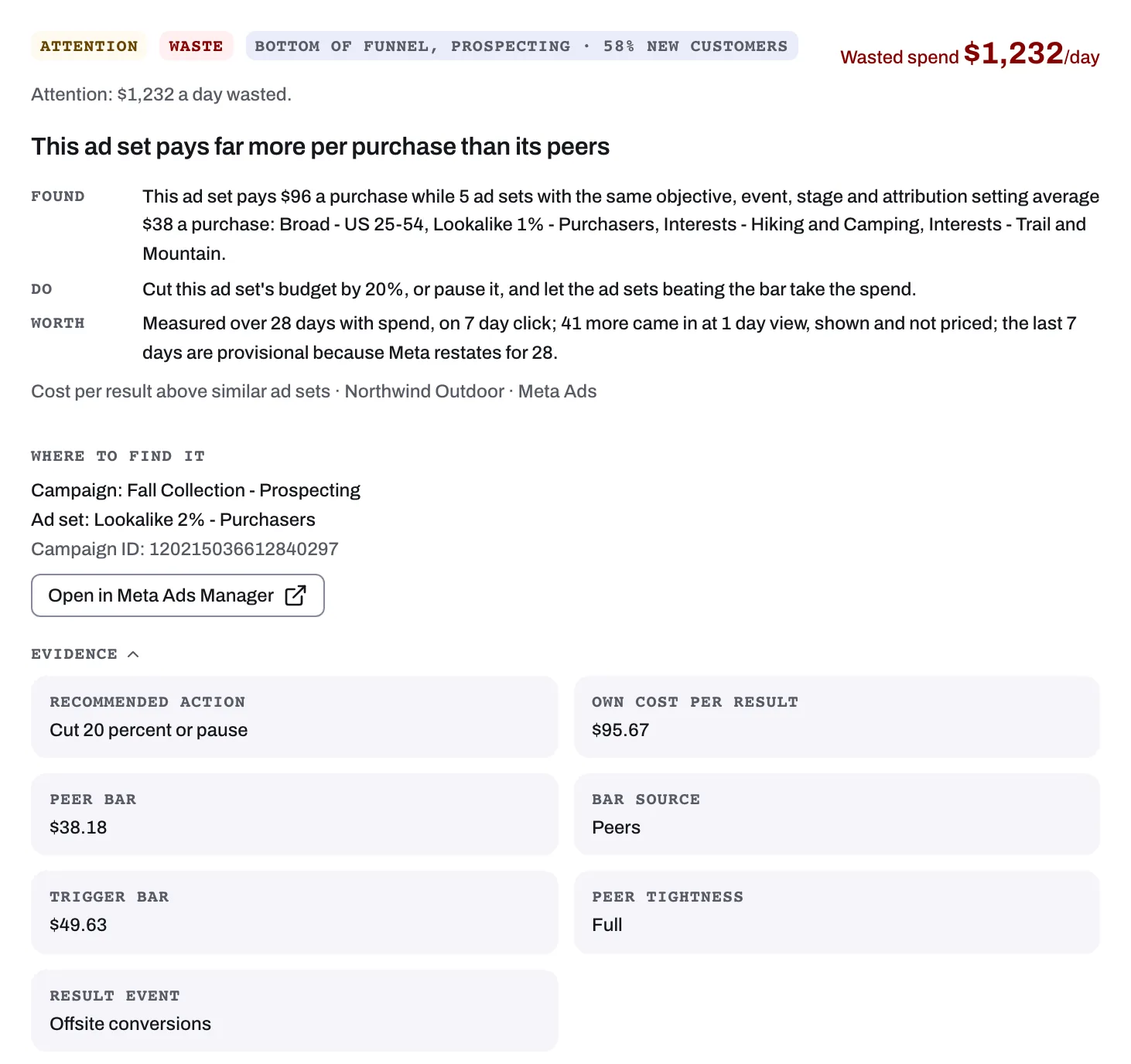
- The title says what was found, for example "Cost per result above similar ad sets".
- The stage shows the ad set's funnel stage; the card names the exact campaign, ad set, ad or placement.
- The money figure appears on cost cards (no results, cost above similar ad sets, return under target) as an estimate per day. Other cards show what to fix, without a figure.
- The evidence shows the rule applied and the measurements that met it: spend, results, cost per result, the similar ad sets compared and the time window.
- Open in Meta Ads Manager opens the exact item.
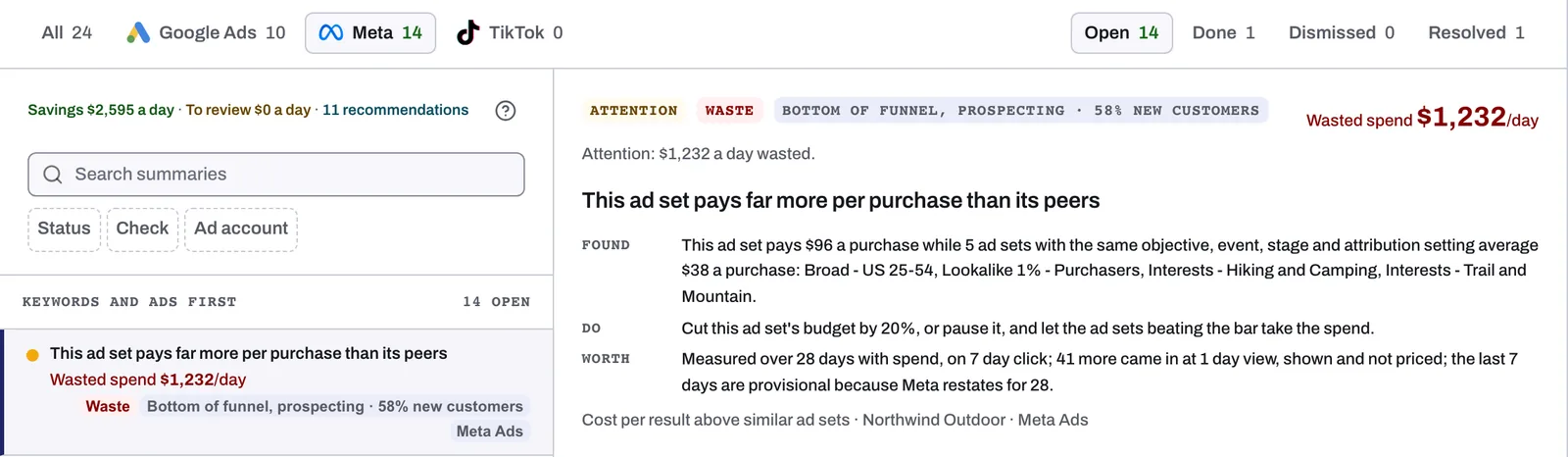
A card is Open (waiting for a decision), Done (you made the change in Meta Ads Manager and marked it done), Dismissed (you decided it is not for this account; it stays in the list) or Resolved (the problem is gone, for example because the ad set changed or was removed, or the data no longer meets the rule). See Read a Lift card: money, priority and evidence and How Lift works on Meta Ads.
Was this helpful?
Related articles
Still need help?
Chat with our team and mention this article.