

Set your Meta targets: cost per result, frequency and budget split
On this page
Workspace targets tell Lift what good looks like on a Meta ad account: what a result should cost, your return on ad spend goal, how often one person should see an ad, and how the budget splits across funnel stages. Several Meta checks read them. Each account has its own targets in its own currency, never converted.
Before you start
- You need the Owner, Admin or Manager role.
- The entity needs a connected Meta ad account: see Connect Meta Ads for Lift.
- Bands apply by funnel stage, so check each ad set's stage first: see Check the funnel stage Lift gives each Meta ad set.
Set your targets
- With several protected entities, pick one in the switcher under the workspace name.
- Under Lift in the sidebar, select Business details.
- Pick Meta in Areas, then Workspace targets.
- With several Meta ad accounts, pick one in Ad account.
- Fill in the fields you know (table below).
- Press Save on the save bar. It saves only what you changed.
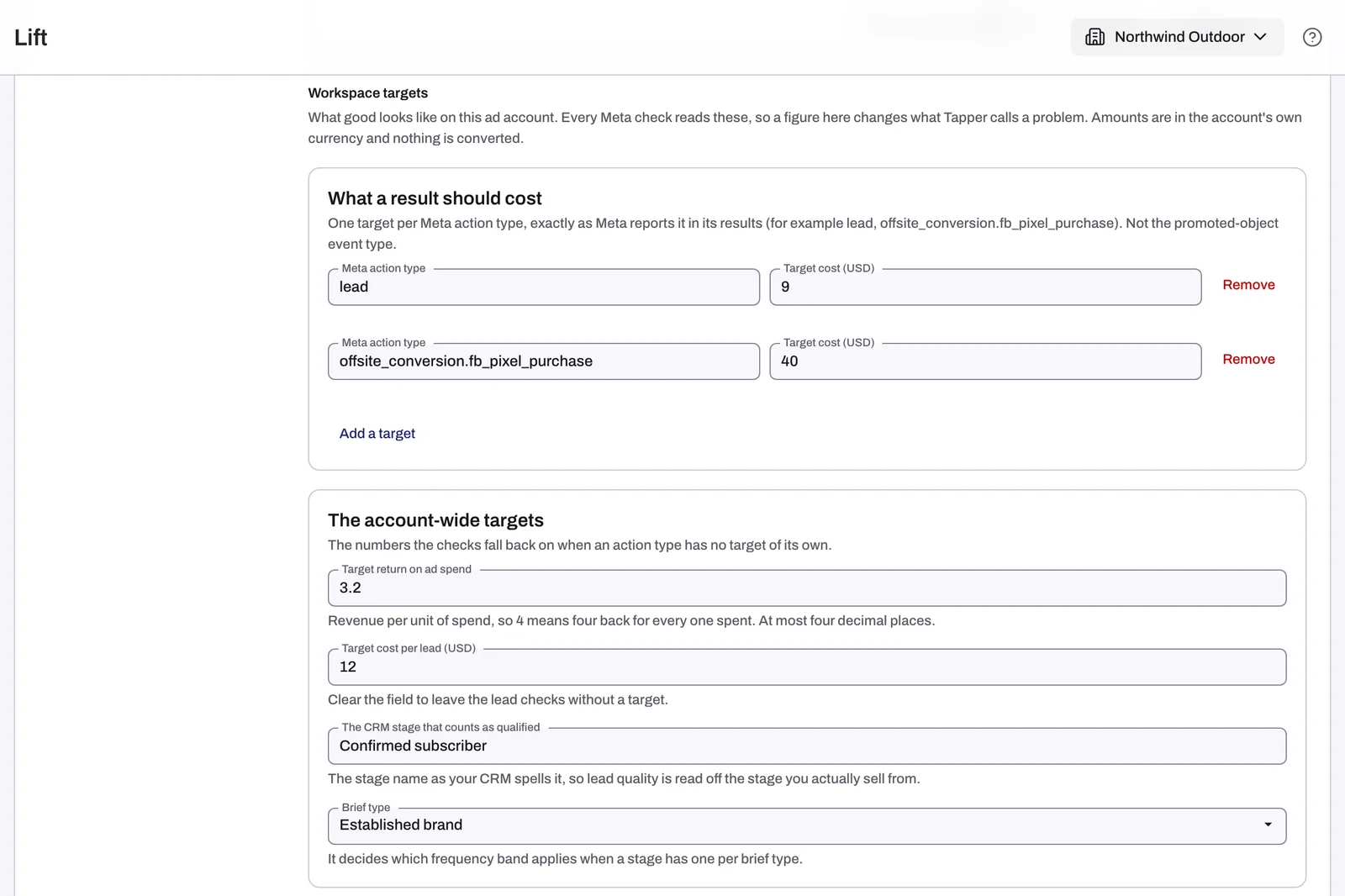
What each target does
| Field | What to enter | Which checks read it |
|---|---|---|
| What a result should cost | Up to 32 rows: the Meta action type exactly as Meta reports it, such as lead or offsite_conversion.fb_pixel_purchase, and its Target cost. | Ad set for existing customers missing its target judges only against it, and raises no card without it. Cost cap flags a cost or bid cap above it. One place the ads appear costing more than the rest of the ad set judges a placement other than Audience Network once it has spent that much (otherwise, the ad set's own cost per result). |
| Target return on ad spend | Revenue per unit of spend: 4 means four back for every one spent. | Return on ad spend under target over 3 days and 7 days flags a return under it over both the last 3 and 7 days (otherwise, it compares cost per result with similar ad sets). Cost cap flags a minimum return goal below it. |
| Target cost per lead | A cost per lead. | No check. To give lead ad sets a target, add their action type, such as lead, under What a result should cost. |
| The CRM stage that counts as qualified | The stage name as your CRM spells it. | No check. |
| Brief type | Not set, Established brand, Launch or Burst. | Picks the frequency band. Not set, or a brief type with no band for the stage, uses Established brand. |
| How often one person should see an ad | Per Funnel stage and Brief type: Lowest and Highest impressions per person per 7 days. | Top of funnel: People seeing the ads more often than planned (otherwise 1 to 2 a week) and People seeing the ads too few times a week to remember them (no card without a band). Middle of funnel: Highest is the limit for People who know the brand seeing the ads too often as clicks fall (otherwise 6 a week). Other stages: no check. |
| How the budget should be split | Per Funnel stage: Lowest share, percent and Highest share, percent of spend. | Funnel stage getting more or less budget than planned judges each stage against your band or, without one, an industry reference: Top of funnel 40% to 80%, Middle 15% to 30%, Bottom 10% to 20%, Retargeting 5% to 30%. It runs once 90% of spend is in staged ad sets; its card calls the stages awareness, consideration, conversion and existing customers. |
| Most of the spend that may go to existing customers, percent | A share of the account: 15 means 15 percent. | No check. |
| Budget may be moved between campaigns | A switch, off by default. | On: Budget to move from a weaker ad set to a stronger one can suggest moving budget from another campaign. Off: only within the same campaign. |
| Meta enhancement and What is allowed | One row per creative enhancement, by its Meta name, and whether Meta may use it, such as off. | New launch set up differently from the rest of the account lists a new ad using one you do not allow. |
| Expected languages | Languages separated by commas (en, fr, es by default). | No check. |
| Leads from this account get a call | A switch, off by default. | No check. |
| Add a quiet period | A First day and Last day, like 2026-12-24, and optionally What it is. | No check: a quiet period pauses nothing. |
A target cost counts only for a conversion result, such as a purchase, lead or install, never link clicks, landing page views or add to cart. No results after real spend, the Cost per cards (such as Cost per purchase) and Cost per lead above similar ad sets keep comparing with similar ad sets: a target is your aim, similar ad sets show what the account actually pays.
What happens next
A save applies from the next daily check. Cards are re-scored then: new ones can appear, and one that no longer applies leaves the open list, with no saving counted. Some cards name the figure used, such as "our default of 1 to 2 a week" or "the range set for this account".
If something goes wrong
- No Meta ad account: the block only describes itself, and Accounts under Meta in the rail shows a small hollow circle (Not connected). Connect one first.
- This account has no currency on record: amounts save as typed, but the page cannot name their currency. Reconnect the account; if the notice stays, contact your Tapper contact.
- Save does not go through: a field shows an error. "Use a Meta action type as the key." means the key has a space or a sign other than a dot, underscore or hyphen, or starts with one of those. On the existing customers field, "Must be between 0 and 1." asks for a plain number from 0 to 100, with no % sign.
- A target changes nothing: check that the action type matches the result letter for letter, that the band's stage and brief type are the ones read, and that a daily check has run since you saved.
Related
Was this helpful?
Still need help?
Chat with our team and mention this article.