

How Lift works on Meta Ads
On this page
Every day Lift reads each connected Meta ad account (Facebook and Instagram alike) and lists what is worth changing as cards under the Meta tab of the Lift page. The checks are in The checks Lift runs on Meta Ads.
Which accounts Lift checks
Once Tapper has set your workspace up, every Meta ad account connected to a protected entity. Connecting starts it (Connect Meta Ads for Lift). Lift first reads up to 90 days of history, so the first cards usually come the next day. No cards after a few days: see No Lift recommendations yet.
An account Tapper can no longer read is not checked until you reconnect it, and its cards stay as they were. An account that cannot run ads (not active in Meta, or no payment method) gets only Ad account disabled or flagged by Meta and Spending limit or balance close to stopping delivery.
What Lift reads, and when
Once a day Lift reads how the account, campaigns, ad sets and ads are set up (budgets, bids, goals, attribution, targeting, creative and more) and their daily results, with breakdowns such as placement, age and gender, and country. It never reads payment card or invoice details, and reading changes nothing.
- Each daily check judges the previous day, in the account's reporting time zone. A change in Ads Manager shows after the next check; the top of Recommendations says when the list was last updated.
- Meta updates results for 28 days, so Lift rereads the last 28 days daily (7 for ads), and a priced card says "the last 7 days may still change".
- Money is counted over the last 28 days; triggers use the last 3, 7 or 14 days. The Detection window in Setup is for Google Ads only.
What counts as a result
What the ad set is set to get, from its performance goal and optimization event, not the campaign objective: purchases, leads, registrations, app installs or ThruPlays, for example. Link clicks, landing page views and add to cart never count as conversions, so an ad set optimizing for one gets no money figure.
Results use the ad set's own attribution setting: 1-day click, 7-day click, or click and view. On a click-only setting, results within a day of a view are shown, not priced. A day with spend but no results returned counts as unknown, never zero.
Funnel stages
Each ad set gets a stage, shown as a tag on its cards, read from its goal and audience (never its name, unless you set a naming rule). The stage decides which checks run and which ad sets it is compared with:
- Awareness goals: Top of funnel. Consideration goals: Middle of funnel. Conversion goals: Bottom of funnel.
- The sub-segment says who it reaches: prospecting (Advantage+ audience counts as new people), retargeting (site or app visitors) or re-engagement (people who engaged, which puts a conversion ad set in Middle of funnel too).
- Existing customers only: Retargeting. Unplaceable: Not classified yet, judged only by the checks that run on every stage.
- If your business is leads (your sign-up answer Leads, or else the business type Leads (forms, calls, sign ups) on the entity's Google Ads accounts, when they agree), lead goals count as conversion goals.
- With audience segments set up in Ads Manager, the tag adds who it reached, as in Bottom of funnel, prospecting · 62% new customers. That never changes the stage.
The full table and how to correct a stage: Check the funnel stage Lift gives each Meta ad set.
Similar ad sets and the bar
Cost comparisons use ad sets on the same account with the same objective, result, stage and sub-segment, attribution setting, countries and languages (all-languages matches any language in its country).
- Lift needs 3 with 5 or more results each. With fewer, it drops the sub-segment, never country, language or attribution; still too few, no comparison card.
- The bar is pooled: their total spend divided by their total results.
- An ad is compared only with its own history.
- A Cost per card needs 5 or more results; a retargeting ad set is compared only with retargeting ad sets including the same audiences.
Target-based checks read your Workspace targets instead: see Set your Meta targets: cost per result, frequency and budget split.
How the money is worked out
Six checks price their cards, all on conversion ad sets; every other Meta card reads Not priced. Money is per day, in the account's currency, never added across currencies. A card worth under 1 of that currency a day is not shown.
- The figure is the last 28 days' spend beyond what the results would cost at the bar, divided by the days it spent, capped at a day's spend. A small ad set's cost per result is first pulled toward its peers'.
- No money without spend in the last 7 days, with spend on fewer than 14 of the last 28 days, or with spend only in the last 3 days.
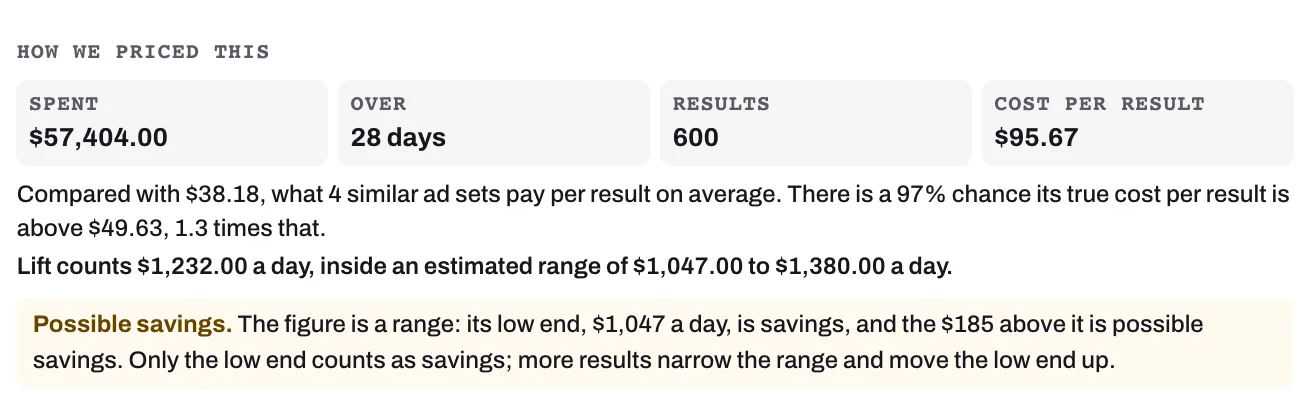
- At a 90% or higher chance it really pays more than its bar, the low end of its range is Savings and the rest Check first; under 90%, all is Check first. How we priced this shows the working.
- A Cost per card (such as Cost per purchase) or Cost per lead above similar ad sets shows "There is a {N}% chance its true cost per result is above {amount}, 1.3 times that." That is a different test: the chance of paying over 1.3 times the bar, which must be 90% or more for the card to show. The chance behind the split is not shown.
Rules Lift never breaks on Meta
- Never spend more: budget advice is a cut or a move that keeps the total; caps only tighten, return goals only rise.
- Leave learning alone: no card on a learning ad set, except from the three learning checks and New launch set up differently from the rest of the account. An ad set counts as learning when Meta says so, and for 7 days after a significant edit.
- Settled, active ad sets only: otherwise no card with spend on fewer than 7 of the last 28 days, or a campaign that spent nothing in the last 3 days. Pause what a card is about and it moves to Resolved at the next check, with no saving counted.
- You make the change: Open in Meta Ads Manager takes you there; then press Mark as done.
The daily data check
- The day's settings and results must have arrived, and Tapper's last 7 days of spend must match Meta's. If not, no card opens or closes that day, and open cards leave the list and totals until a complete check, returning with their first Detected date if still found.
- A priced card no longer found leaves Open without appearing under Resolved, and no saving is counted.
- When results per click fall by more than half on most ad sets at once, Lift shows one card, Tracking break: results per click fell on most ad sets at once. Until results recover, and for 7 days after, cards that read results leave the list.
Where the other parts of Lift apply
- Business details' General and Google Ads areas, Reasons, the Campaign settings findings and the Products page cover Google Ads. Export report covers Meta too.
- Not for this account on a Meta card stops that check on the account and closes its open cards. To switch it back on, contact Tapper support (How to get help from Tapper).
Related
Was this helpful?
Still need help?
Chat with our team and mention this article.