

Read a Lift card: money, priority and evidence
On this page
Each card in Recommendations is one finding in a Google Ads or Meta Ads account. Every card opens with what to do, then why, then the evidence, and shows the money per day where Lift can price it. Its buttons: Fix, mark as done, dismiss and revert.
Find your cards and open one
Open Lift in the left menu, then Recommendations. Each row is one card: the headline, its tags, its money and a Fix or Review button. The day comes first and the month sits beside it, such as "$360 a day, $10,800 a month".
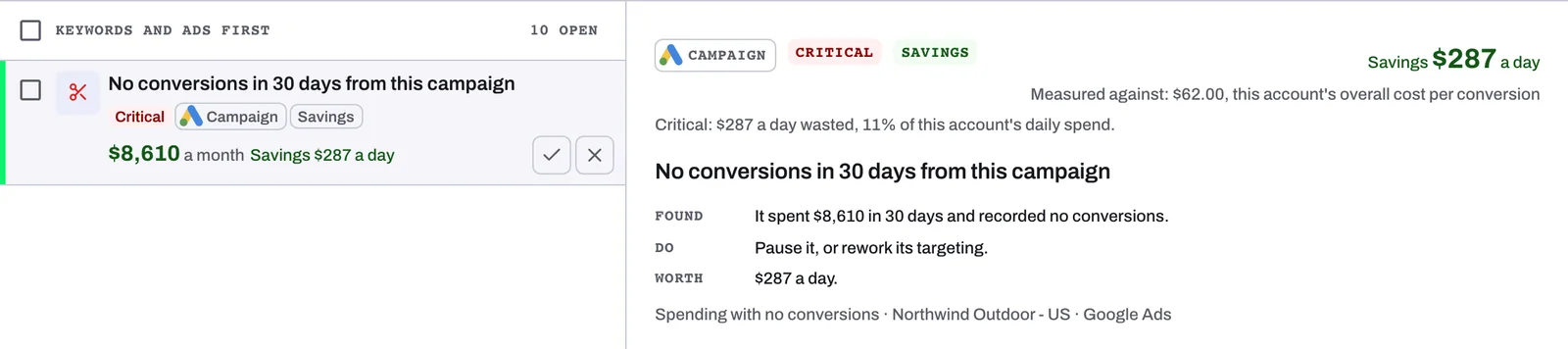
Press a row to open its card beside the list. On a wide screen the top card is already open. On a phone it opens as its own page, with Back to the list.
Tags on a row, in order:
- The severity (Critical, Attention, Low impact) or the priority (High priority, Medium priority, Low priority), or Counted in campaign total when another card on the campaign already counts this money.
- New until you open the card.
- Changed since last check, Unchanged or First seen on a card about a campaign setting.
- The platform logo and the level, such as Campaign, Ad group, Keyword or Ad set.
- The kind: Savings, Optimisation, Tune target, Over target or Upside. Two checks use their own word, Below target and Could do better.
- Check first · and its first reason.
- Conversions at stake on Over target cards.
- The funnel stage on Meta cards.
What a card shows, top to bottom
The top of the card tells you what to do:
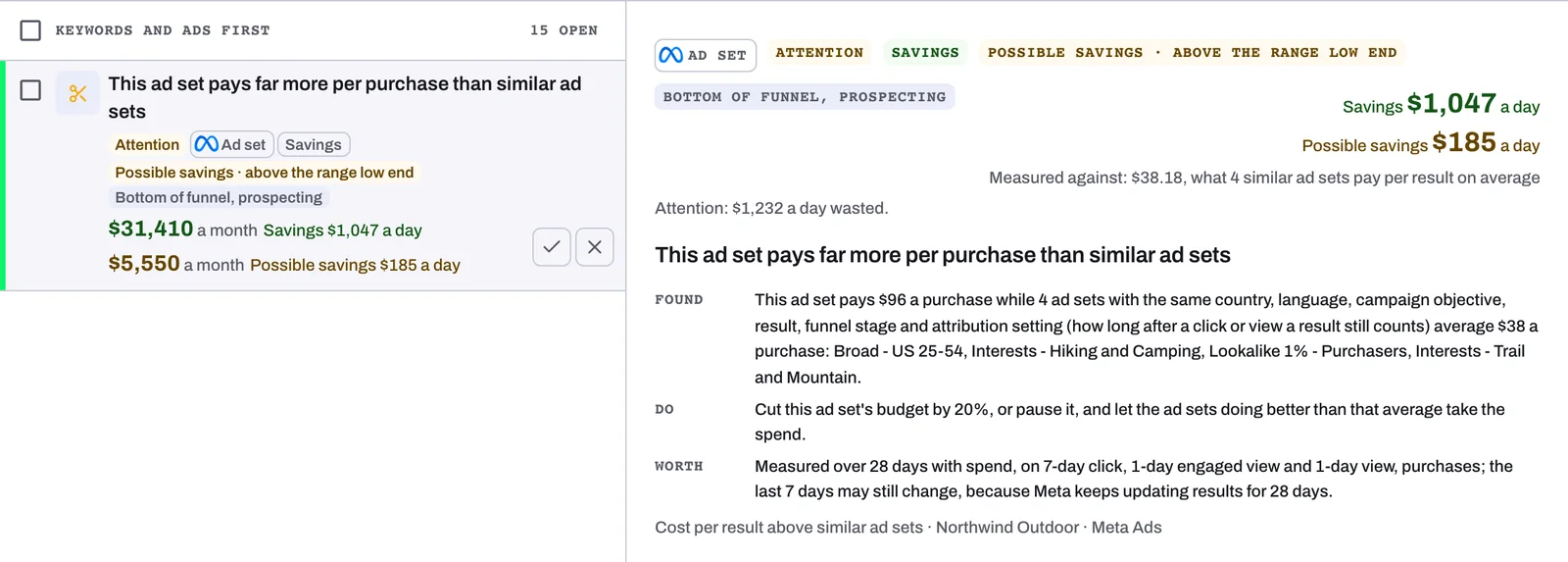
- Tags and money, with a Measured against: line where the card names its comparison, such as "Measured against: $24.00, what similar ad sets pay per result".
- The priority line: why the card has its severity or priority.
- The headline.
- Do, Found and Worth, in that order, then Where when the card names a place. Do is what to do. Found and Worth are why: what Lift saw and what it is worth. On Meta cards Worth says how Lift measured. Do gives way when the headline already says it, and Worth when the card has no money. A card with no lead gives one sentence saying why.
- The context line: the check, the ad account and the platform.
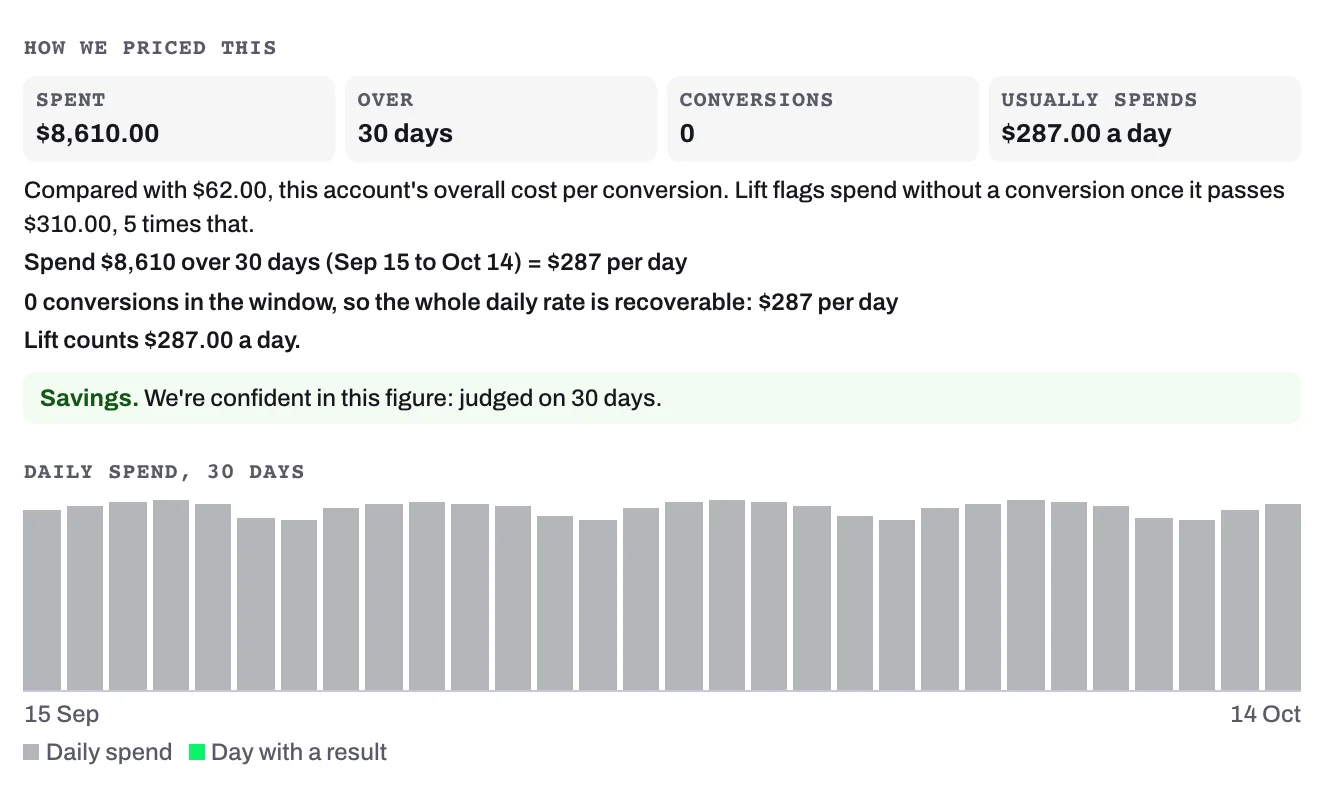
Below that, the card shows the proof:
- How we priced this and, on a whole-campaign card, Daily spend, N days: bars for the last 30 full days, green on a day with a result.
- The buttons, which stay in view as you scroll.
- Where to find it.
- Evidence.
- Why this exists, on a Google Ads card that belongs to a wider cause.
- History.
An amber Check first. line with its reason sits under the lead where there is money to check first but no How we priced this.
The money
Per day, in the ad account's currency, in whole units (cents only under 10). How we priced this shows cents. A row in a currency other than US dollars adds dollars in brackets when Tapper has the rate, such as "AED 10,890 ($2,965) a month". Press the ? beside the card's money to see what the figure is made of.
| Money label | What it is |
|---|---|
| Savings {money} a day | Wasted spend Lift is confident in |
| Check first {money} a day | Wasted spend whose figure rests on a judgement: look before you act |
| Below your target {money} a day | Spend above what the campaign's own target allows |
| Could do better: {money} a day | What an ad loses to the best ad in its ad group |
| Potential upside +{money} a day | What a tighter bid target could gain on the same budget, an estimate |
| Affects {money} a day of spend | The spend a recommendation is about |
| {money} a day, counted at campaign level | Already counted on another card for the campaign |
| For review, not priced | Single words to check: a negative on one word blocks every search containing it |
| Not priced | A finding with no figure |
Why money is marked Check first
The tag names the first reason. How we priced this names them all.
| Tag | Reason | When it counts as savings |
|---|---|---|
| brand campaign | Few conversions can be brand protection | Once marked as not brand protection |
| judged on under 14 days | Under 14 days of data, such as since a target changed | At 14 days of data |
| different kind of campaign | Compared with another kind, such as Display against the account's overall cost per conversion | When compared with the same kind |
| app conversions? | Priced on app conversions as Google counts them | Once Adjust is connected and the campaign is matched |
| purchases counted twice?, conversion value broken?, conversion count changed? | Another open card says the campaign's figures may be wrong | Once that card is fixed or dismissed |
| budget cut recently | Priced on the days since a budget cut | At 7 days of spend since the cut |
| benchmark from one campaign | One campaign sets the benchmark | Once other campaigns carry enough conversions to set it |
| above usual spend | The campaign's cards add up to more than its usual daily spend | Never, for the part above it |
| under a 90% chance | Meta: under a 90% chance it costs more than its comparison | At 90% or more, for the low end of its range |
| above the range low end | Meta: only the low end of the range is savings | As more results raise the low end |
On a brand card, press Mark as not brand protection: the money counts as savings once the daily check runs. Undo takes it back. Nothing changes in the ad account.
Severity and priority
Both measure the whole daily figure (savings plus check first) against the account's average daily spend:
| Share of the account's daily spend | Waste card | Other cards |
|---|---|---|
| 5% or more | Critical | High priority |
| 1% or more | Attention | Medium priority |
| Under 1% | Low impact | Low priority |
A Google Ads card in its campaign's last 7 days stops at Attention. The priority line gives the reason, such as "Critical: {money} a day wasted, {share} of this account's daily spend." A card with no money ranks low.
How we priced this
On a waste card the daily check has sorted, this always-open block shows the working from the card's own numbers.
- The figures: Spent (or, say, Spent on these 3 search terms), Over, Conversions and Cost per conversion or Usually spends. On Meta: Results and Cost per result.
- The comparison, such as "Compared with $38.50, the benchmark cost per conversion.", often with the rule that raised the card.
- The working, ending on the figure: "Lift counts $228.00 a day." On Meta the figure sits inside an estimated range.
- The box: green "Savings. We're confident in this figure: judged on 30 days." or amber Check first. with the reasons.
Google Ads figures use the account's Detection window: 30 days unless you change it in Lift > Rules > Judging.
Where to find it, Evidence and History
Where to find it names the campaign and, where they apply, the ad group or ad set and the item, then Campaign ID: for searching in the ad platform.
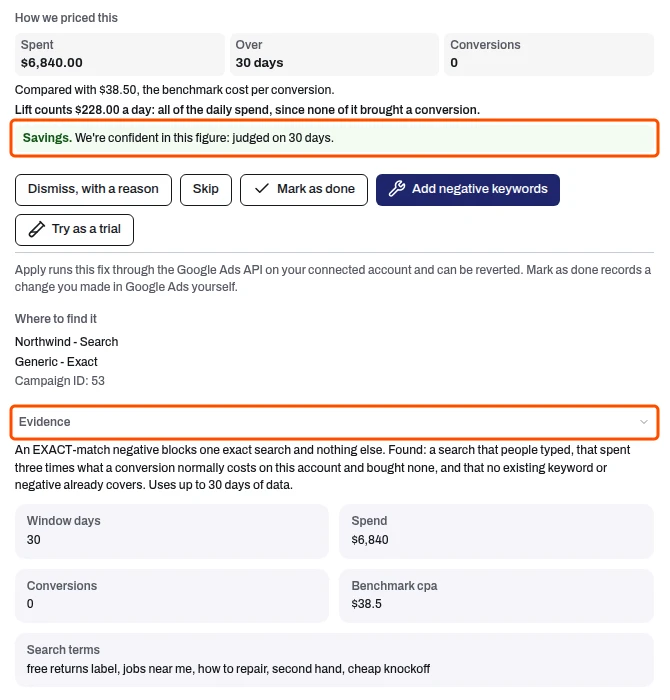
Evidence opens when pressed. It holds the proof behind the card, as in the picture:
- A notice when a target, budget or bid strategy change shortened the days judged.
- The rule, with its numbers.
- How this number was calculated, where there is no How we priced this.
- The figures the check measured, and tables of what it found, such as search terms, placements or ads.
With a contribution margin set in Business details, under Products and margins, a ROAS card such as Return on ad spend under target adds Margin on ad spend (ROAS times margin) and Breakeven ROAS (1 divided by margin) to its Evidence, for reading only.
Why this exists is open by default. It names the cause behind a group of cards, what to do about the whole batch, the figures and how Lift worked them out. More: Reasons and the fix plan.
History, at the foot of the card, shows Detected and Last seen, who opened the card and every change made to it.
When a card leaves the list
Lift closes a card when it stops finding the problem. You find it under Resolved. A savings card worth under 1 a day in the account's currency is not shown, and closes once below that.
Meta cards
They read the same way, except:
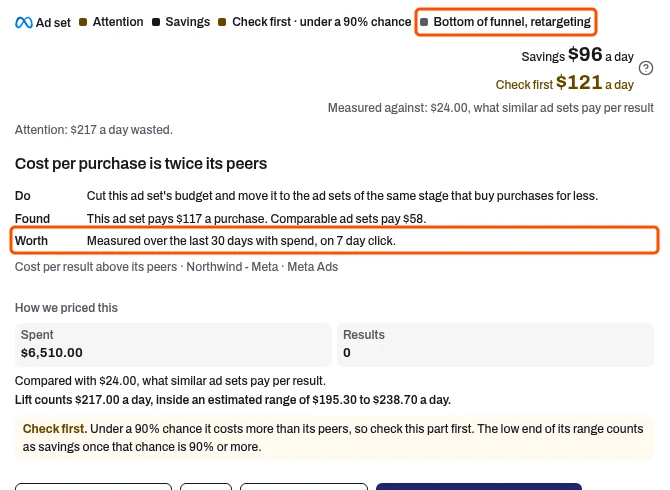
- Funnel stage: see Check the funnel stage Lift gives each Meta ad set.
- Found compares the ad set with comparable ad sets, and Worth says how Lift measured.
- Priority line: no share of daily spend, as in "Attention: {money} a day wasted."
- Links out: Open in Meta Ads Manager opens the campaign, ad set or ad.
More: How Lift works on Meta Ads.
Related
Was this helpful?
Still need help?
Chat with our team and mention this article.