

Check the funnel stage Lift gives each Meta ad set
On this page
Every Meta ad set gets a funnel stage, which decides the checks that run on it and the ad sets it is compared with. Lift works it out daily from the ad set's goal and audience, and Meta cards show it as a chip, such as "Bottom of funnel, prospecting". The Stage map shows every ad set's stage and why, and lets you correct it.
How Lift gives an ad set its stage
| Who the ad set reaches | Awareness goal | Consideration goal | Conversion goal |
|---|---|---|---|
| People with no history with the brand | Top of funnel | Middle of funnel, prospecting | Bottom of funnel, prospecting |
| People who have engaged with the brand | Top of funnel | Middle of funnel, re-engagement | Middle of funnel, re-engagement |
| People who have visited the site or used the app | Top of funnel | Middle of funnel, retargeting | Bottom of funnel, retargeting |
| Existing customers only | Top of funnel | Retargeting | Retargeting |
Retargeting alone means existing customers.
- Goals. Awareness: reach, impressions, video views, ThruPlay, post engagement, and anything bought as Reservation. Consideration: link clicks, landing page views, messaging, calls and leads, including conversion leads (an offsite conversion or value goal that buys a lead). Conversion: other offsite conversion and value goals, and app installs. Lift reads the ad set's goal, and the campaign objective only when the ad set has none.
- Lead generation. On a lead generation account, lead goals (instant forms, quality leads, quality calls, booked appointments, conversion leads) count as conversion goals. A Meta account counts as lead generation when you answered Leads to "How do you measure success on your ads?" for its entity at setup or, without that answer, when the entity's Google Ads accounts all agree. Setup has no business type for Meta, so if lead ad sets still read Middle of funnel, set their stage yourself.
- Audiences, in this order (exclusions never count): Advantage+ audience on means no history with the brand; an audience Tapper cannot identify means Not classified yet; any website, app or dataset audience means site or app visitors; any engagement or video audience means engaged; only customer lists or offline conversion audiences mean existing customers; anything else (interests, lookalikes, broad) means no history.
- Not classified yet also covers an unreadable goal. Awareness ad sets are always Top of funnel. Unclassified ad sets get only the checks that run on every stage, such as learning and account checks.
Open the stage map
You need the Owner or Admin role.
- Under Lift in the sidebar, select Business details.
- Pick Meta in Areas, then Stage map.
- With several Meta ad accounts, pick one in Ad account.
What the stage map shows
Ad sets grouped by campaign, highest 7-day spend first. Each campaign's "Whole campaign" row has a box that selects the whole campaign.
| Column | What it shows |
|---|---|
| Ad set | Name and Meta ID. |
| Stage | Stage and sub-segment, when Lift last read it ("Read", in your workspace time zone) and, if you or a naming rule decided it, what Tapper's classifier read. |
| Decided by | Set by you, From a naming rule or Tapper's classifier. |
| Why | The goal, who it reaches, the audiences it targets and excludes, and any matching naming rule not in use. |
| Audience split | How Meta split the last 7 days of spend between new, engaged and existing customers. Never changes the stage; empty until audience segments are set up in Ads Manager. |
| Spend, last 7 days | In the ad account's currency. |
Filter by Stage or Decided by, or search by ad set or campaign name.
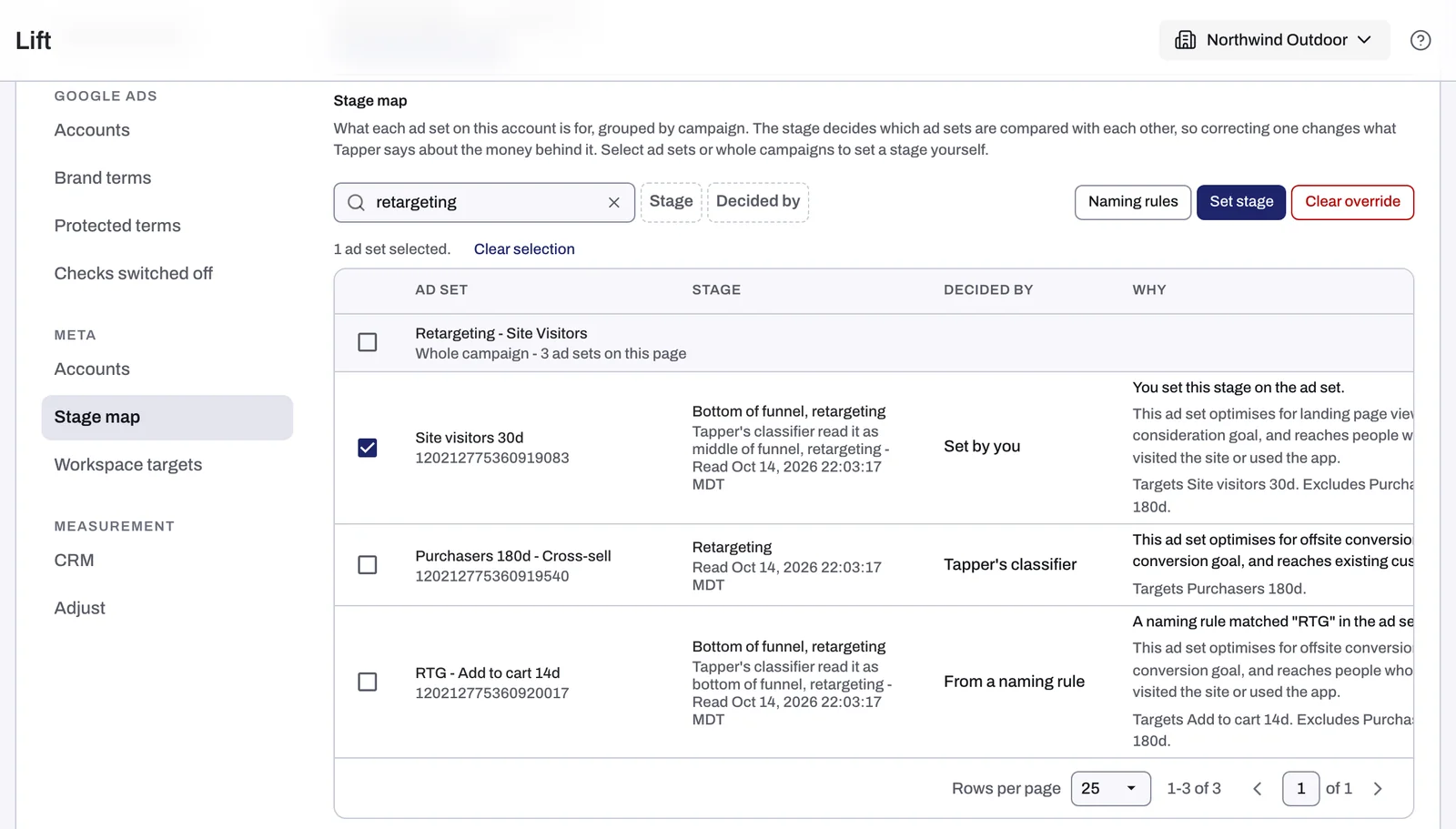
Set the stage yourself
- Tick each ad set to change, or a campaign's row for the whole campaign.
- Press Set stage.
- Pick the Funnel stage: Top of funnel, Middle of funnel, Bottom of funnel or Retargeting.
- Optionally pick a Sub-segment: prospecting, retargeting or re-engagement.
- Press Set stage.
The first answer wins: a stage you set on the ad set, then on its campaign, then a naming rule with both switches on, then Tapper's reading (still shown beside yours). A campaign's stage covers all its ad sets, including later ones. To undo, tick what you set, press Clear override and confirm.
When a change takes effect
Changes save at once and apply from the next daily read: Stage, Decided by and Why update then, new ad sets appear, and cards follow at the check after. A card from a check that no longer runs at the new stage moves to Resolved, with no saving counted.
Read stages from your ad set names
A naming rule sets the stage from text your names use, such as "tof" or "remarketing".
- Above the table, press Naming rules, then Add a rule.
- In Text in the name, type up to 64 characters. It matches anywhere in the ad set or campaign name, ignoring capitals.
- Pick the Funnel stage and, optionally, a Sub-segment.
- To let it decide by itself, turn on Switched on and Use it for ad sets added later (both start off).
- Press Save rule.
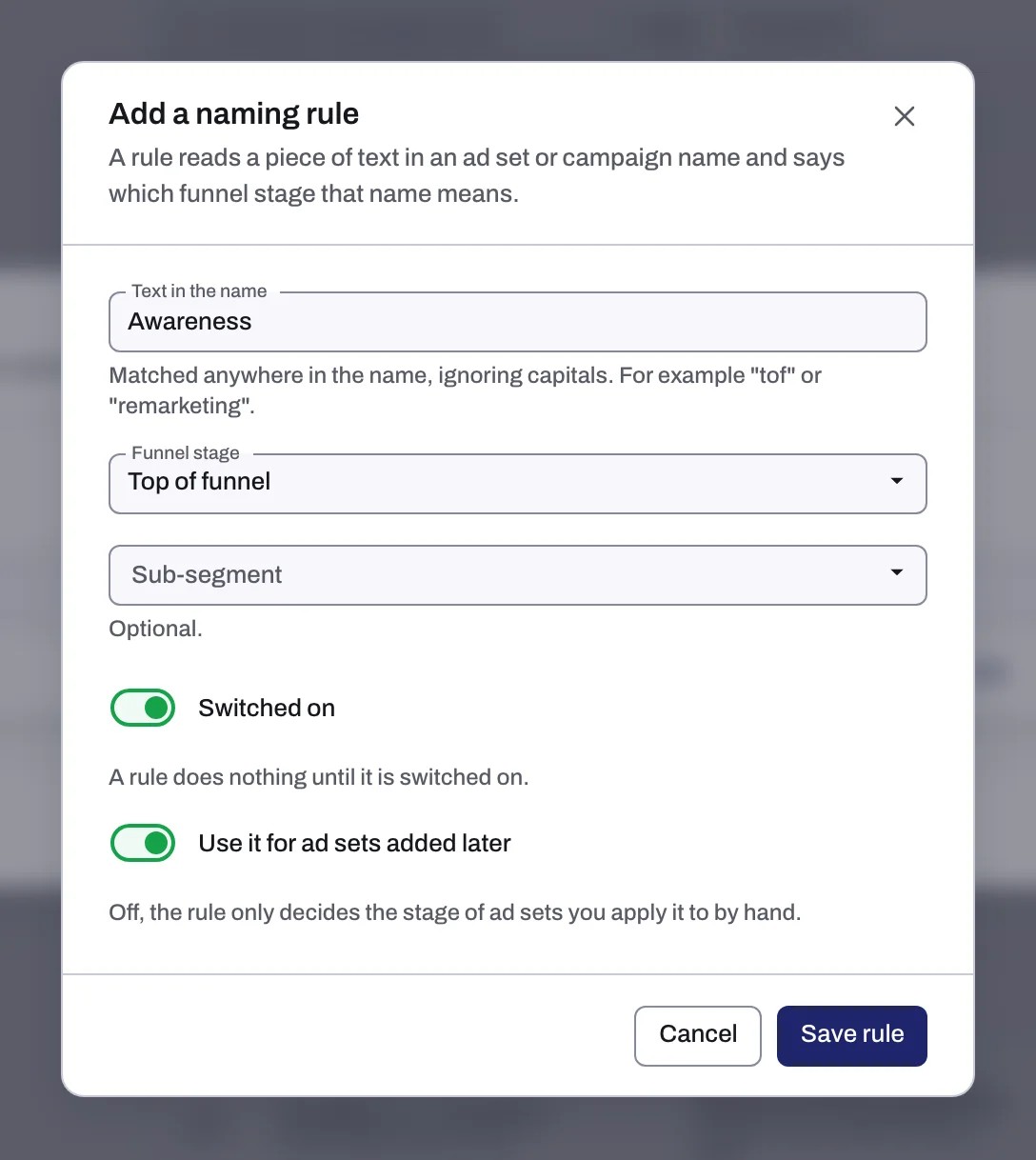
- With both switches on, the rule decides every matching ad set, existing and new, unless you set one yourself. The ad set's name is checked before its campaign's; with two matches, the longer text wins.
- Apply now sets the rule's stage, as set by you, on today's matches, whatever its switches: press Check what matches, then Apply.
- Edit changes stage, sub-segment and switches, not the text: for other text, delete and add another.
- Delete stops the rule. Apply now stages stay until you clear them; ad sets it decided go back to Tapper's reading, or another matching rule, at the next read.
If the map is empty
"No ad sets match" with "This account has no ad set snapshots yet." means Lift has not read the account yet. An account that needs reconnecting is not read: reconnect it. If your workspace is new and the map stays empty, contact your Tapper contact.
Related
Was this helpful?
Still need help?
Chat with our team and mention this article.