

Fix, mark as done, dismiss and revert
On this page
On Google Ads, many cards carry a fix button: press it, check the change, confirm, and Tapper makes it. For any other change, make it in the ad platform, then mark the card as done. A card that does not fit can be dismissed or skipped. You need the Owner, Admin or Manager role to act on a card; Viewer members can read cards but not act on them.
The buttons on a card
Press a row in Recommendations to open its card (on a phone, as its own page). The buttons sit above Where to find it and stay in view as you scroll:
- Dismiss, with a reason, Skip and Mark as done on open cards.
- Revert this fix where Tapper can undo a fix.
- Reopen on a card you marked as done or dismissed.
- A fix button with a wrench icon, named for its change (Google Ads).
- Open in Meta Ads Manager on a Meta card.
Nothing changes until you confirm the dialog a button opens. Links into a card (such as Review in the weekly email), row buttons, the menu on a row and keyboard keys only open the card or the dialog. One press acts on one card. Acted-on cards move from Open to Done or Dismissed. Resolved holds cards a daily check closed, for example because it no longer finds the issue.
On a Monthly budget off track card, Adjust monthly budget opens Business details at the account's Monthly budget. Change it, or empty it to turn the check off, and press Save. Nothing changes in Google Ads.
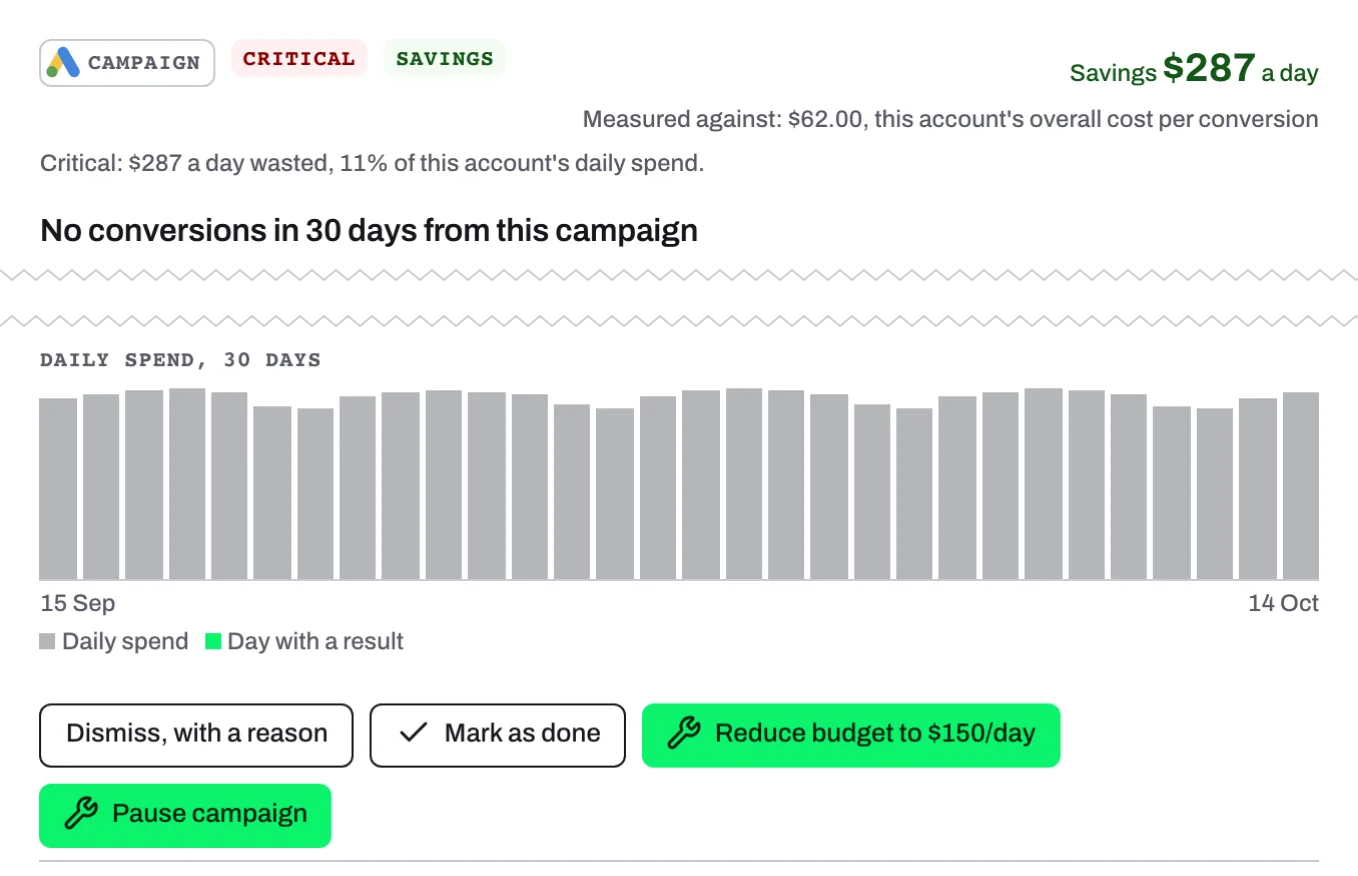
Fix it in one press
On Google Ads
- Press the card's fix button.
- Check the change and confirm with the button of the same name.
The card moves to Done. If part of the change lands, the fix counts as applied. If nothing lands, a red message says so and the card stays open.
| Button | What changes in Google Ads |
|---|---|
| Exclude placements | Adds the placements to the account-wide exclusion list. |
| Turn off Search Partners | Turns off Search Partners for the campaign. |
| Turn off Display expansion | Turns off the Display Network for the Search campaign. |
| Add negative keywords | Adds the search terms as exact-match negatives. |
| Add phrase negatives | Adds phrase-match negatives; each blocks every search containing its pattern. |
| Pause keywords | Pauses the flagged keywords that are enabled. |
| Pause ad | Pauses every ad the card flags, across the campaign's ad groups. |
| Tighten target CPA to {money} | Lowers the target CPA by 20%. |
| Raise target ROAS to {n} | Raises the target ROAS by 20%. |
| Reduce budget to {money}/day | Lowers the daily budget, by at most half per press. |
| Pause campaign | Pauses the campaign if it is enabled. |
Spending with no conversions, Far more spend than the conversions are worth, Cost per conversion over target and Return on ad spend under target offer their buttons as alternatives. A budget or target button shows only when Tapper can work out its figure: never for a shared budget or a portfolio target. Other Google cards have no fix button.
On Meta Ads
- Press Open in Meta Ads Manager. The campaign, ad set or ad opens in a new tab.
- Make the change there.
- Back in Tapper, press Mark as done.
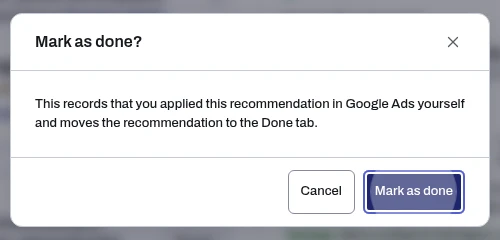
Mark as done
- Press Mark as done, the Mark as done item in the row's menu or the E key.
- Confirm with Mark as done.
Nothing is sent to the ad account. The card moves to Done and counts as acted on this month on the dashboard's Recovered spend. Unmarked, it stays open until a daily check no longer finds the issue, and does not count. To mark several, tick them on Open and use Mark as done in the list header.
A message offers Undo for a few seconds. Later, open the card on Done and press Reopen.
Dismiss a card
For a card that does not fit how you run the account, such as a brand campaign you keep on purpose. A dismissed card stays dismissed.
- Press Dismiss, with a reason, the Dismiss item in the row's menu or the D key.
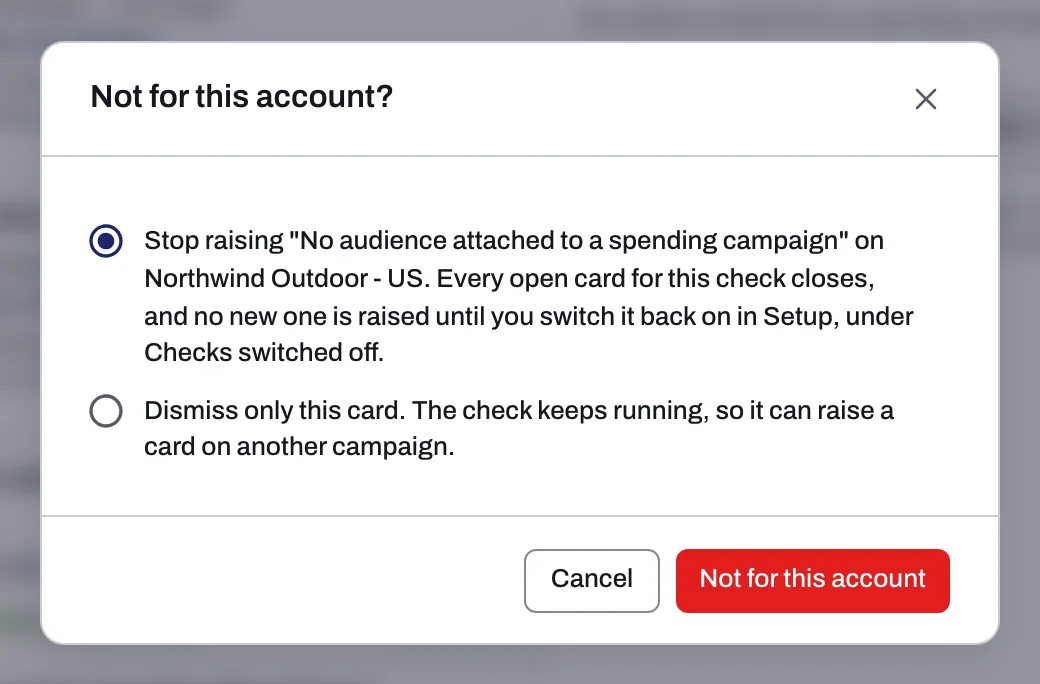
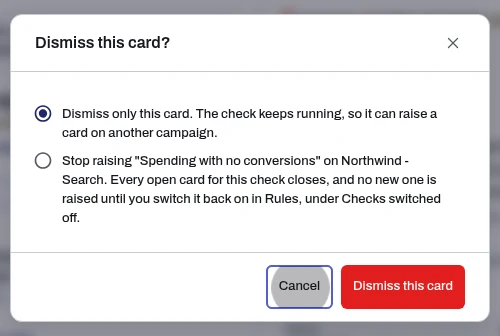
- In Dismiss this card?, pick a reach. The default dismisses only this card; the check keeps running, so it can raise a card on another campaign. The second choice stops the check on this ad account and closes every open card of it.
- Confirm with Dismiss this card or Not for this account.
The card moves to Dismissed. A message offers Undo for a few seconds; later, press Reopen on the card. After the second choice:
| Platform | What happens |
|---|---|
| Google Ads | No new card of that check on the account. To switch it back on, open Lift > Rules > Checks switched off, pick the Ad account and press Switch back on. Or open one of its dismissed cards and press Reopen and switch the check back on. |
| Meta Ads | No new card of that check on the account. To switch it back on, open one of its dismissed cards and press Reopen and switch the check back on. |
Dismiss in the list header dismisses only the ticked cards and never stops a check.
Not a conversion campaign
On Google Ads, a card that judges a campaign on its cost per result, such as Spending with no conversions or Cost per conversion over target, adds a choice: Not a conversion campaign. Use it for a campaign you run to be seen, not to convert. Lift then stops judging that campaign on its cost per result, and its other open cost per result cards close with this one. Confirm with Not a conversion campaign.
Undo on the message, or Reopen on the card, takes the answer back, and Lift judges the campaign on its cost per result again.
Kept for reach
A Meta placement card adds Kept for reach: you keep that placement on purpose, so Lift stops raising it on the ad account. Other placements are still checked. Confirm with Kept for reach. To take it back, press Undo kept for reach on the card.
Skip a card
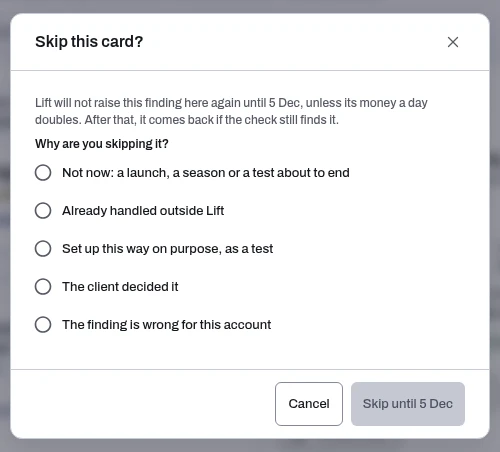
Skip is for a finding that is right but not for now, such as a launch, a season or a test about to end. It hides the card for 30 days, then it can come back.
- Press Skip or the Skip item in the row's menu.
- In Skip this card?, choose why. Nothing is chosen for you, and the button stays off until you pick one:
- Not now: a launch, a season or a test about to end
- Already handled outside Lift
- Set up this way on purpose, as a test
- The client decided it
- The finding is wrong for this account
- Confirm with Skip until and the date, such as Skip until 5 Dec.
The card moves to Dismissed, with a line that says until when and why. Lift does not raise the same finding again before that date, unless its money a day doubles. After it, the card comes back if the check still finds the issue. A skip covers only this card and never stops a check. Undo on the message, or Reopen on the card, brings it back at once.
Revert a fix
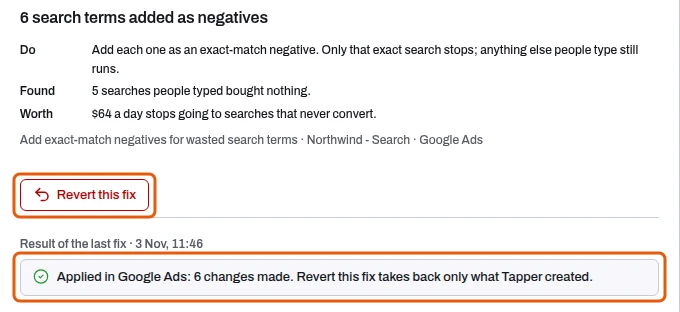
You can undo a Tapper fix, with no time limit. The button undoes the card's most recent fix.
- Open the card on Done.
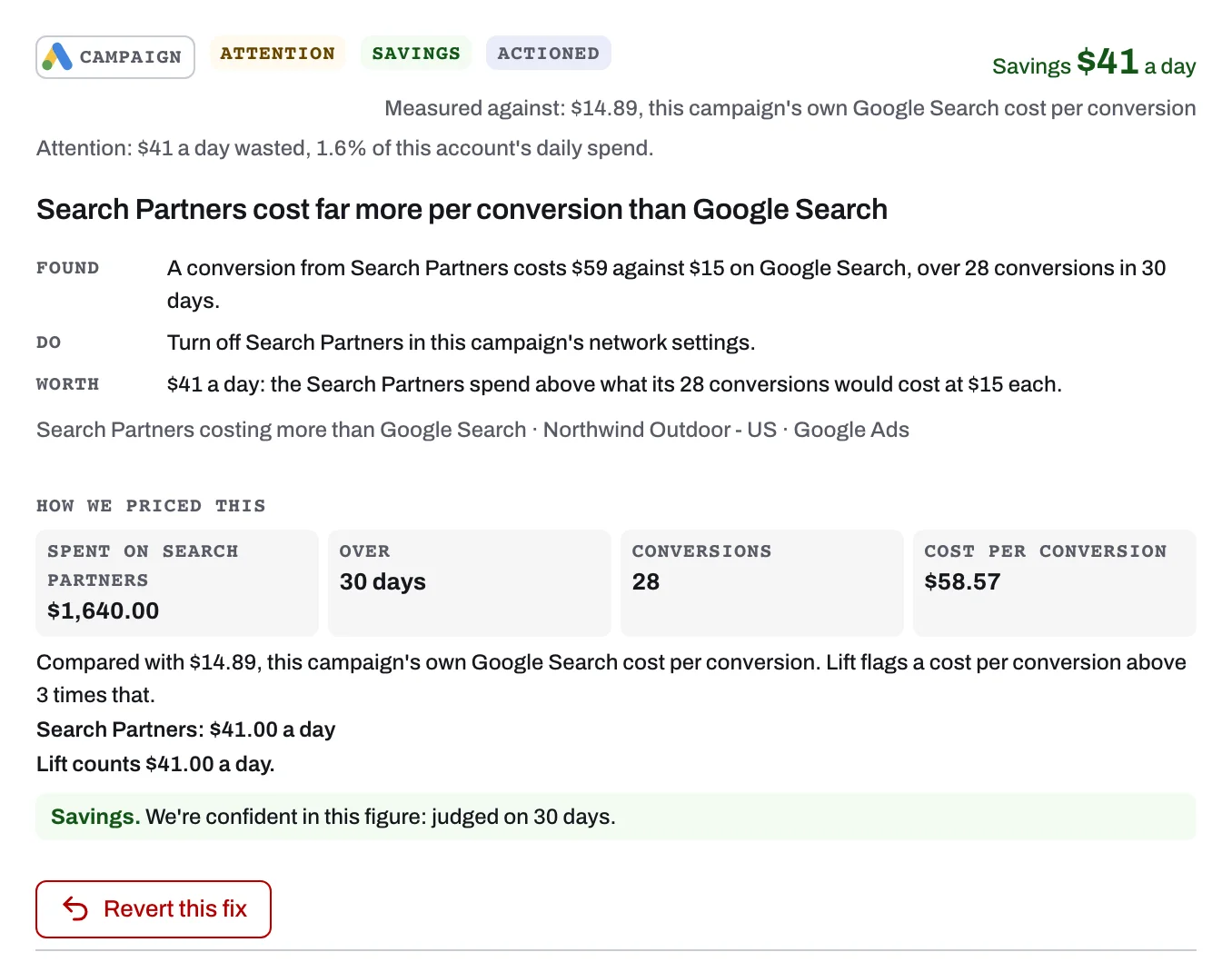
- Press Revert this fix (red, with an undo icon) and confirm with Revert.
A revert removes the exclusions and negative keywords Tapper added, such as the ones from Add negative keywords, and puts statuses, budgets, targets and network settings back to their values before the fix. Your own exclusions and negatives are never touched. After a full revert the card returns to Open. If some changes stay live, a red message says how many; revert again.
Result of the last fix sits under the buttons and says what the fix changed.
What Lift never changes
- Anything, until a person confirms a fix. The one exception is an automation band on Google Ads: see Automatic fixes and the Activity tab.
- Your total budget, upward: no fix raises it, and Lift never recommends spending more in total.
- A shared budget, a portfolio target, or a campaign target when its ad groups set their own.
- Your own exclusions and negative keywords.
- Anything outside Google Ads.
If something goes wrong
- The fix button is grayed out. A line under the buttons gives the reason, such as "Write access has not been verified for this ad account yet, so fixes cannot be applied." Ask your Tapper contact; meanwhile make the change in Google Ads and mark the card as done.
- A target card says the campaign's ad groups set their own targets. Change the ad group targets in Google Ads, then mark the card as done.
- "Tapper hit an error and nothing was saved. Try again in a minute." Press the button again. If a red message says the card is no longer open, someone may have acted first, or the daily check closed it. The list refreshes.
More: A fix was refused or cannot be reverted.
Related
Was this helpful?
Still need help?
Chat with our team and mention this article.