

Lift on the dashboard
On this page
Lift's figures sit on Dashboard, under Analytics in the sidebar, in one of two forms depending on your products (Choose your products: Lift only or Vantage + Lift + Block). The recommendations themselves are in the Lift section: see Lift: what it does and where to find it.
Where Lift shows
- With other products, Dashboard has a tab for each product you hold, and Lift is one of them. The Overview tab shows Lift as one card with its headline figures; the card opens the Lift tab.
- On Lift only, Dashboard is one page with no tabs, holding the same Lift sections.
The Lift tab has a list of five sections on its left, each with its own address, so you can bookmark one:
| Section | What it holds |
|---|---|
| Summary | The tiles, Health, the daily charts and By platform, one row per ad account. |
| Recommendations | The things to do this week, Reasons, Upside, Top recommendations, Where the money leaks and Account watch. |
| Spend | Spend and customers for an online store, your spend across platforms and Spend by platform, one row per platform. |
| Google Ads | Your Google Ads campaigns. |
| Meta Ads | Your Meta campaigns, placements, age and gender, and audience types. |
The dates at the top apply to the whole page, and the Marketing platform and Severity buttons narrow what they can. A card that cannot follow a filter you set says so in a chip. Lift's figures are for Owners, Admins and Managers. With demo data on they are examples: see Demo data.
Summary
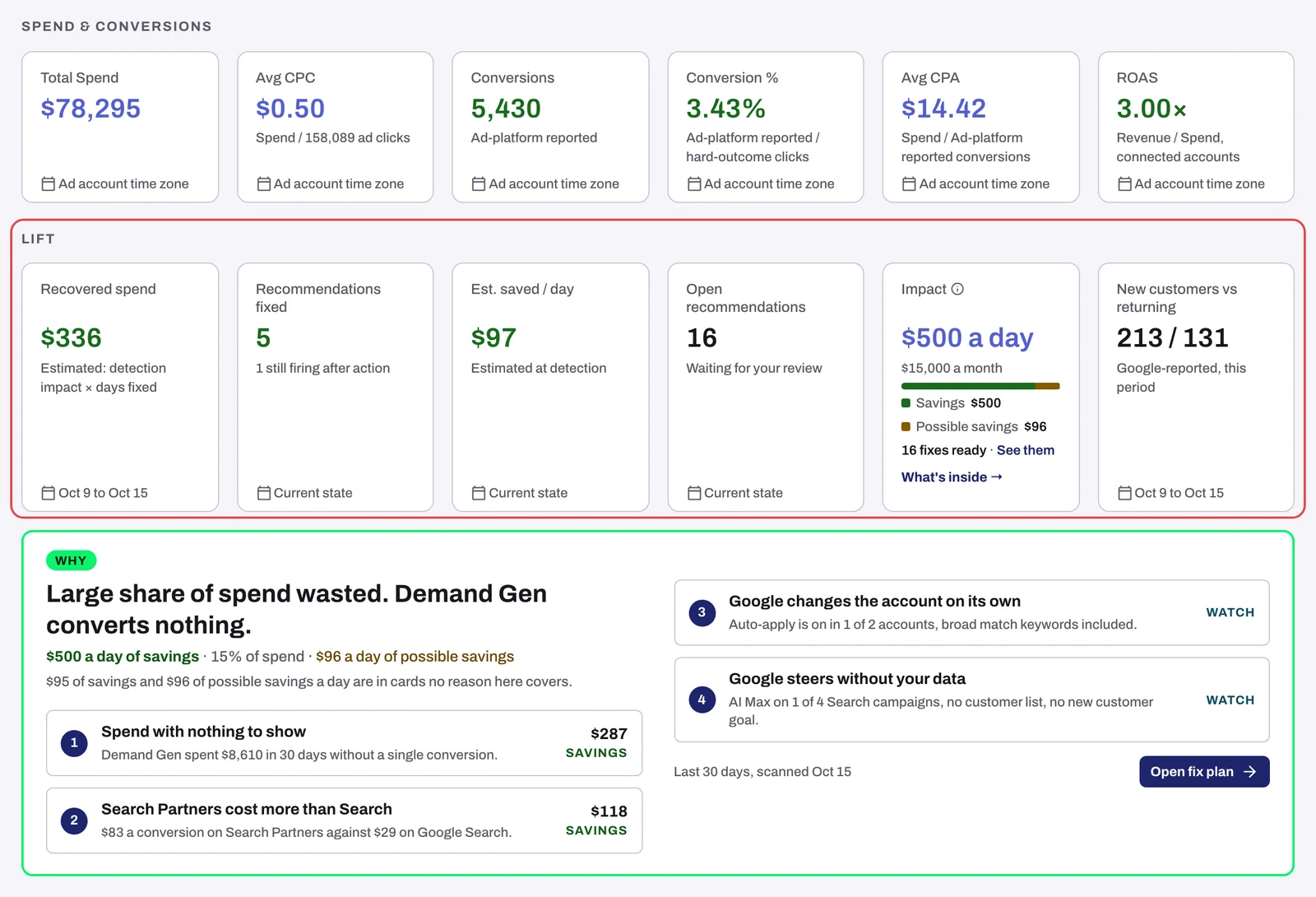
| Tile | What it counts |
|---|---|
| Recovered spend | What fixes are estimated to have saved in your dates, against the same number of days before ("No change vs previous 30 days"). |
| Fixes applied | Fixes you applied or marked as done that were in effect on at least one of your dates, against the days before. |
| Impact | The money on your open recommendations (below). |
| Open recommendations | Every open card, with how many are Critical when some are. |
| Settings to review | Campaign settings Lift expects off that are on, with how many changed recently. |
- Recovered spend and Fixes applied follow your dates. Impact, Open recommendations and Settings to review show the state right now, and say so.
- Amounts are in the ad account's currency. A money tile shows the biggest currency and names the others under it; currencies are never added together.
- A dash (-) means Tapper could not establish the figure. It is never a zero.
Health lists what needs you, each line with its button: recommendations to review, fixes still found after they were applied, an ad account that cannot apply fixes until it is reconnected (Reconnect), campaign settings to review, and the checks on your connections, such as "Google Ads accepts the connection". Show all opens the rest.
Under Health, Ad spend by day (one line per platform) and Spend recovered by day show your dates, then By platform.
One row per ad account

By platform has one row for every connected ad account, named with its platform, such as "Google Ads · Main account":
| Column | What it counts |
|---|---|
| Critical, Attention | Open recommendations on that account, by severity. |
| Waste a day | The daily waste Lift estimates on its open recommendations, in the account's own currency. |
| Fixes in place | Fixes applied on that account. |
These are the numbers as they stand today, whatever your dates. A figure Lift has not been able to read for an account shows a dash (-) in its cell, never a zero. Under the table, Spend, 30 days shows your last 30 days by platform against the 30 before; a platform you have not connected is listed with a Connect link.
How Recovered spend is worked out
For each fixed waste card: the savings a day Lift estimated when it found the problem, times the days the fix was in effect inside your dates (the fix day counts, today does not, in your workspace time zone). Check first money never counts, so a fixed card with no confident part counts as fixed with no money. A fix the check still finds adds nothing. A card at $40 a day fixed 10 days ago adds $400.
Impact
The money priced on your open recommendations, on every platform, before any fix: a day, with the month (day times 30) under it. Two parts:
- Ready to act on: money Lift is confident in.
- Check first: money whose figure rests on a judgement, so look first. Each card says why.
A bar splits it into those parts and Not yet checked (not in the headline). Upside is kept apart and never added in.
Then "{N} fixes ready · See them" (See them opens your recommendations) and What's inside →: the reason behind each part of the money to check first, money by campaign type, by kind of fix and, with several accounts, by account, and the five campaigns carrying the most, each linked to its card.
With nothing at stake it reads "{N} fixes ready" with "No money at stake today", or "Nothing to fix today" when nothing is open.
Recommendations
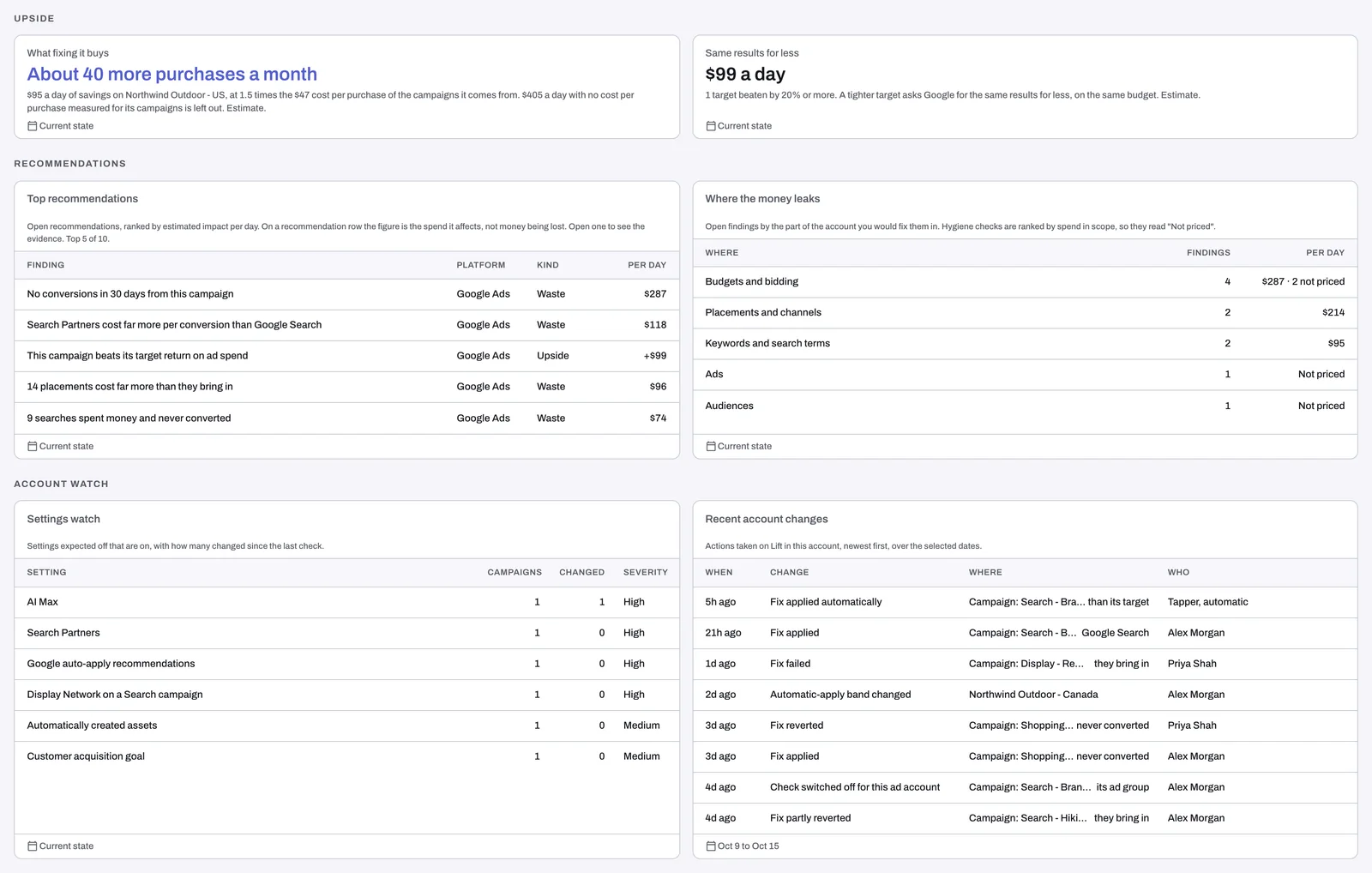
Things to do this week. When Lift has reasons to show, the section opens with a short list of things to do, such as "3 things to do this week" with the daily savings they are worth, each with View recommendations. Reasons inside it explains why wasted spend builds up in your Google Ads accounts: bars compare campaign groups by share of spend and of conversions. What it reads and when it hides: Reasons and the fix plan.
Upside, two estimates per currency:
- What fixing it buys: what your savings would buy on the same budget, such as "About 9 more purchases a month", priced at a multiple of what the source campaigns pay per conversion. Savings with no measured cost are left out, and the line says how much. Check first money never counts.
- Same results for less: the daily total of open target cards where a campaign or ad group beats its target by 20% or more. Never added to savings.
Recommendations:
- Top recommendations: the five open cards worth most a day, with the platform. Kind says what Per day means: money lost on Waste, money a change could gain on Upside (with a +), and spend affected on Recommendation, Tune target and Over target.
- Where the money leaks: the same findings grouped by where you fix them, such as Keywords and search terms. A finding with no price reads "Not priced" instead of a figure.
Account watch:
- Settings watch: open Campaign settings findings, one row per setting, worst first, with how many campaigns have it (an account-wide setting counts once per account), how many changed since the last check, and Severity (High, Medium or Low). A name opens them in your recommendations.
- Recent account changes: the latest Lift actions in your dates, newest first. Who reads Tapper, automatic for Tapper's own actions, such as Closed by Tapper, Email sent or Fix applied automatically (Automatic fixes and the Activity tab).
Spend
The Spend section shows where your ad money went, and what it brought back.
Spend and customers
For a workspace with a Google Ads account whose business type is Online store (you sell products from a catalogue or product feed) or Bookings and subscriptions (tickets, bookings, subscriptions, plans or applications paid online), shown to Owners, Admins and Managers.
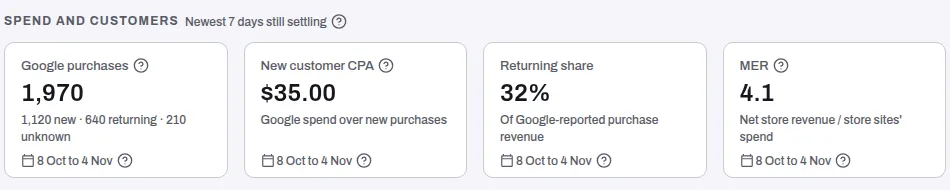
| Tile | What it counts |
|---|---|
| Google purchases | Purchases Google Ads reports, split under it, such as "1,120 new · 640 returning · 210 unknown". Google's purchases, not your store's orders. |
| New customer CPA | Google Ads spend divided by purchases Google counts as new customers. Google cannot split cost by customer type, and other platforms' spend is not in it. |
| Returning share | Returning customers' share of Google-reported purchase revenue. |
| MER | Your store's revenue after refunds divided by the same sites' ad spend, such as 4.1. It leaves out a site whose store or ad account started partway through the 28 days, or with an ad account on a platform not shown. |
- Every tile covers the last 28 full days to yesterday, whatever your dates, shown in its chip (such as 8 Oct to 4 Nov).
- Google keeps adding purchases to the newest 7 days, so they can read low.
- Money is in US dollars, converted at a monthly rate.
- Platform, ad account, campaign and campaign type filters are not applied; the chip says so.
- A dash (-) means the figure cannot be worked out, such as no new purchases.
One row per platform
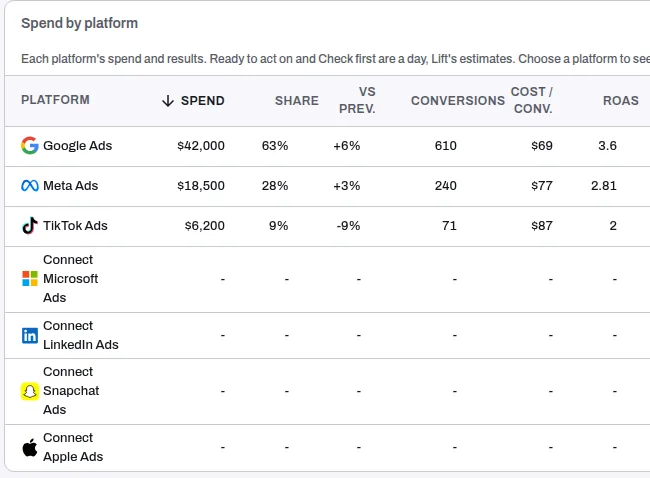
Ad spend, all platforms gives your total for your dates with each platform's part and its change on the days before, and Spend per day stacks the platforms by day. Export CSV downloads the spend behind the section, for your dates and platform.
Spend by platform lists every platform Lift works with, one row each:
| Column | What it shows |
|---|---|
| Spend, Share | The platform's spend, and its share of the total. |
| Vs prev. | Its change on the same number of days before. |
| Conversions, Cost / conv., ROAS | What the platform reports for those dates. |
| Ready to act on / day, Check first / day | Lift's daily estimates on the platform's open recommendations (see Impact). |
| Open | Open recommendations on the platform. |
A platform you have not connected is listed as Connect Microsoft Ads, Connect LinkedIn Ads and so on, with a dash (-) in each column: nothing is counted for it, and it is never a zero. Choose a platform to see it alone.
Why behind the spend sets each platform's share of spend against its share of conversions, with its cost per conversion, so a platform that takes more of your budget than it returns stands out.
Google Ads and Meta Ads
The Google Ads section shows one Google Ads account at a time (pick it when you have several): its spend, conversions, clicks and impressions, then every campaign that spent in your dates, paused ones included, most spend first, with its status, campaign type, conversions, cost per conversion, click rate and cost per 1,000 impressions. More columns adds the rest.
The Meta Ads section opens with Meta's own figures for your dates and, where you have a store connected, Your store: orders from Meta clicks beside them. Every Meta figure is labelled "Meta says", because it is Meta's own count. Meta campaigns lists every campaign that spent, most spend first. Open a campaign to see its ad sets, and an ad set to see its ads. Under it come placements, age and gender, and results by audience type.
Age and gender
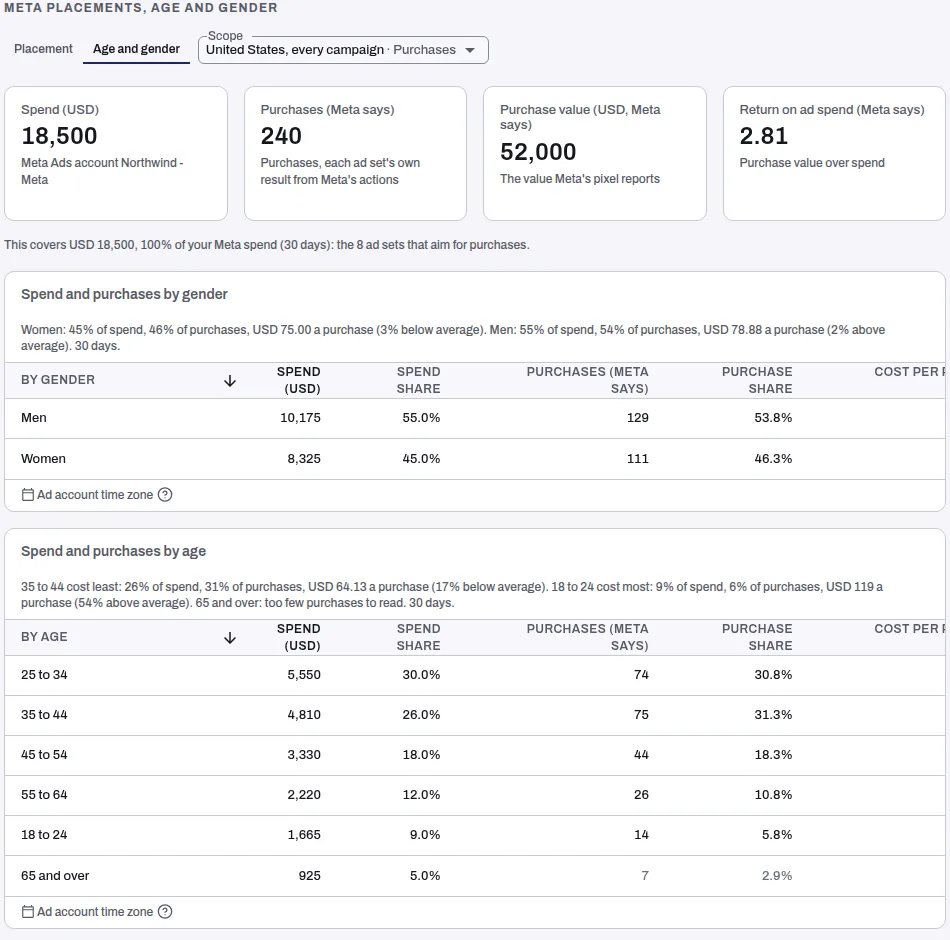
Meta placements, age and gender has two views, Placement and Age and gender. On Age and gender it shows who your Meta spend reached and who bought, for your dates:
- Scope picks the campaigns it covers: a market, one campaign or one ad set. Markets are never added together, and a line under the tiles says how much of your Meta spend the scope covers.
- Spend and purchases by gender: Women, Men and, when Meta does not know, Gender not known, each with its spend, share of spend, purchases, share of purchases and Cost per purchase. A line above says what stands out, such as which gender pays less for a purchase and by how much against the average.
- Spend and purchases by age: the same for each age band, from 18 to 24 to 65 and over. A band with too few purchases to read is greyed and the line above says so; it is never ranked.
- Meta age and gender then lists each age band and gender together, eight rows a page, with Purchase value and Return on ad spend beside the counts.
Where your campaigns aim for leads or other results rather than purchases, the table shows leads or results, with a switch between them, and the cost of each with its 95% range. Show details opens the notes: what every figure counts, and "Nothing here is called waste until qualified leads or sales come back from your CRM, and no age or gender change is suggested."
Meta's days are the ad account's, with the Ad account time zone note on each card. A scope that holds a campaign under Meta's housing special ad category has no age and gender split, and says why. If Meta did not return a breakdown for your dates, the table says it is not known, never zero.
The Lift only dashboard
On Lift only, the same five sections sit on one page with no tabs. Summary has its own tiles, with Spend, 30 days first:
| Tile | What it counts |
|---|---|
| Spend, 30 days | Ad spend over the last 30 full days to yesterday, whatever your dates, with its change on the 30 days before. One tile per currency. |
| Recovered spend | What fixes are estimated to have saved in your dates ("Estimated savings since each fix"), with how many recommendations were acted on this month. Zero is real: no fixed card's savings fall in those dates. |
| Recommendations fixed | Cards fixed from Lift or marked as done, plus those the daily check saw fixed in the ad platform. Shown once there is one; "{N} still firing after action" counts those still found. |
| Est. saved / day | The daily waste Lift estimated on those cards when found ("Estimated"). Shown once one carries money. |
| Open recommendations | Every open card, Campaign settings findings included. |
| Impact | The money on your open recommendations. |
| New customers vs returning | Google's split of conversions, or Not configured when no customer acquisition goal is set in Google Ads. For an online store, Google purchases takes its place. |
| Settings to review | Campaign settings Lift expects off that are on ("Expected off, found on", or "{N} changed recently"). |
The platform buttons narrow the page. New customers vs returning, Settings to review, Spend and customers and Account watch cannot follow them and say so in a chip. No other filter is followed.
Notices at the top
Campaign settings need review shows on both kinds of workspace while a High settings finding is open: "{setting}: flagged on {N} campaigns", and how many other High settings need review. Review settings opens your recommendations on its Campaign settings findings. It has no close button and goes once every High finding is fixed, dismissed or no longer found. Emails: Lift emails: settings alerts and the weekly summary.
If your workspace is new and Open recommendations stays at 0, contact your Tapper contact: see No Lift recommendations yet.
Related
Was this helpful?
Still need help?
Chat with our team and mention this article.