

Lift's Business details: business type and Google Ads settings
On this page
Business details tells Lift how to read your accounts. Except for the automation bands, nothing here changes your ad accounts: it changes what Lift looks for in its daily checks. You need the Owner, Admin or Manager role (what each role can do).
Open Business details
- Under Lift in the sidebar, select Business details. It opens on General.
- Pick an area in Areas, then a tab.
| Area | Its tabs | What it holds |
|---|---|---|
| General | Business type | How each ad account makes money. |
| Google Ads | Judging, Conversions, Brand terms, Competitor names, Protected terms, Allowed partners, Checks switched off, Merchant Center (where offered) | What Lift reads in each Google Ads account, and how it judges it. |
| Products | Merchandising list, Label feed | Which products Lift pushes or holds, on an online store. |
| Meta | Ad accounts, Stage map, Workspace targets, Meta's recommendations | How Lift reads each Meta ad account, and what it judges results against. |
| Measurement | Data sources, Adjust | Where Lift reads your own results from. |
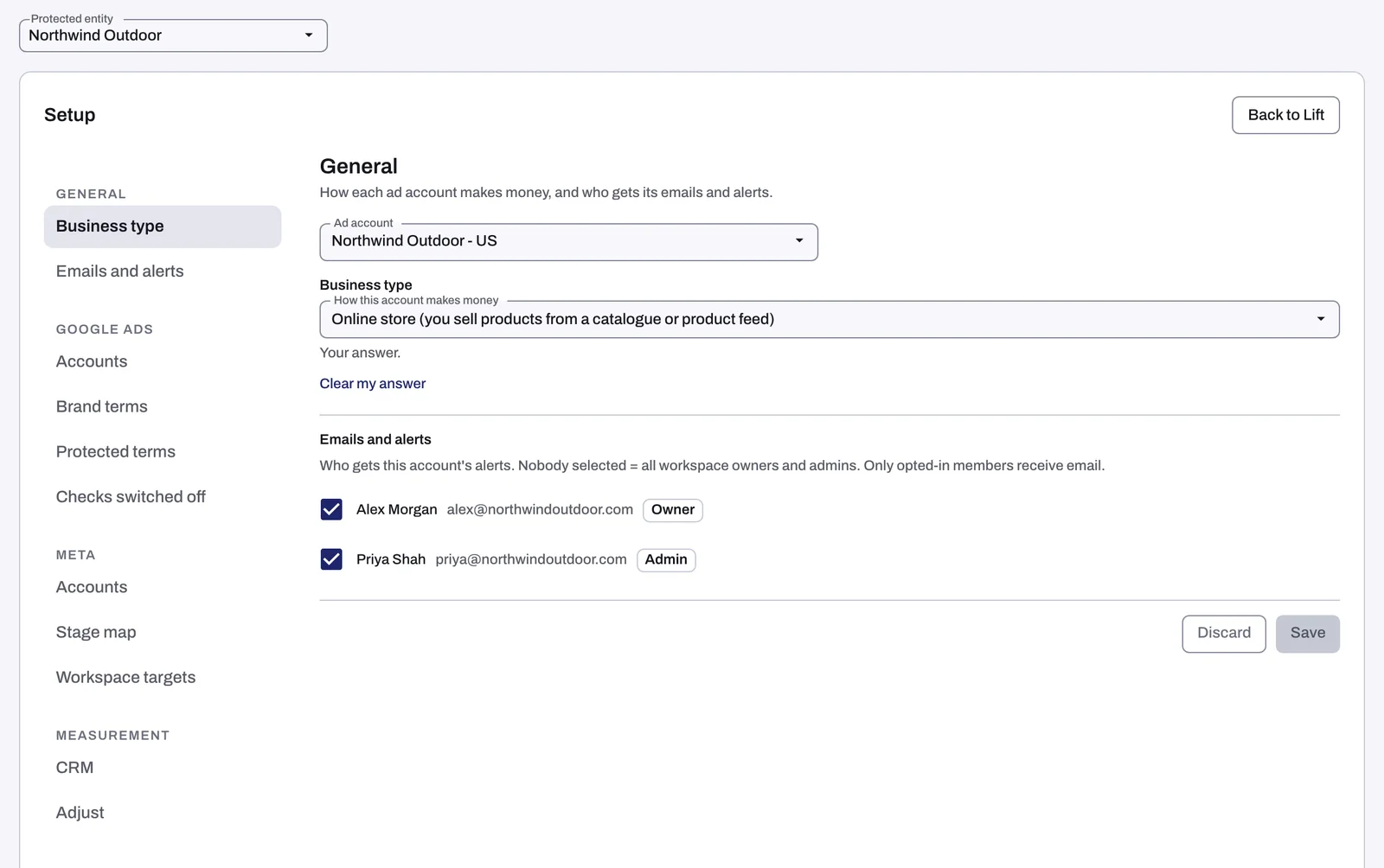
Business details covers one protected entity (switch it under the workspace name), and most settings belong to the account picked in Ad account. The Google Ads settings Lift watches are in Recommendations (Account settings Lift watches); Lift emails are in Settings > Alerts (Lift emails).
Save your changes
One Save covers the page: the save bar appears once anything changes, and leaving with unsaved changes asks first. Some saves ask you to confirm with Save anyway:
- This changes what is checked: a new detection window or ad testing floors, or ROAS turned off. Some open cards close at the next daily check, without counting as fixed, and others may appear.
- This lets Tapper change this account on its own: setting an automation band.
General: business type
Needs a Google Ads account; otherwise "Available once a Google Ads account is connected."
How this account makes money offers Online store (you sell products from a catalogue or product feed), Bookings and subscriptions (tickets, bookings, subscriptions, plans or applications paid online), Leads (forms, calls, sign ups) and App installs and in-app actions:
- Online store adds the Products page: see The Products page.
- Online store and Bookings and subscriptions add Spend and customers to your dashboard: see Lift on the dashboard.
- Leads leaves out the new-customer checks.
- App installs and in-app actions, once answered (a reading of the data is not enough), leaves out new-customer and product checks, and the account's money is to check first, since it rests on app conversions as Google counts them.
The line under the answer says where it came from. An answer from sign up or read from the data has Confirm: press it to make it yours, or choose another, then save; cards follow at the next check. Clear my answer drops yours on save. "Set by Tapper" means ask your Tapper contact. A Meta account takes your sign-up answer, or the entity's Google Ads accounts' answer when they all agree.
Google Ads
With no Google Ads account, the area offers Connect Google Ads: see Connect or reconnect Google Ads for Lift. Judging holds the settings below; Conversions holds Conversions counted.
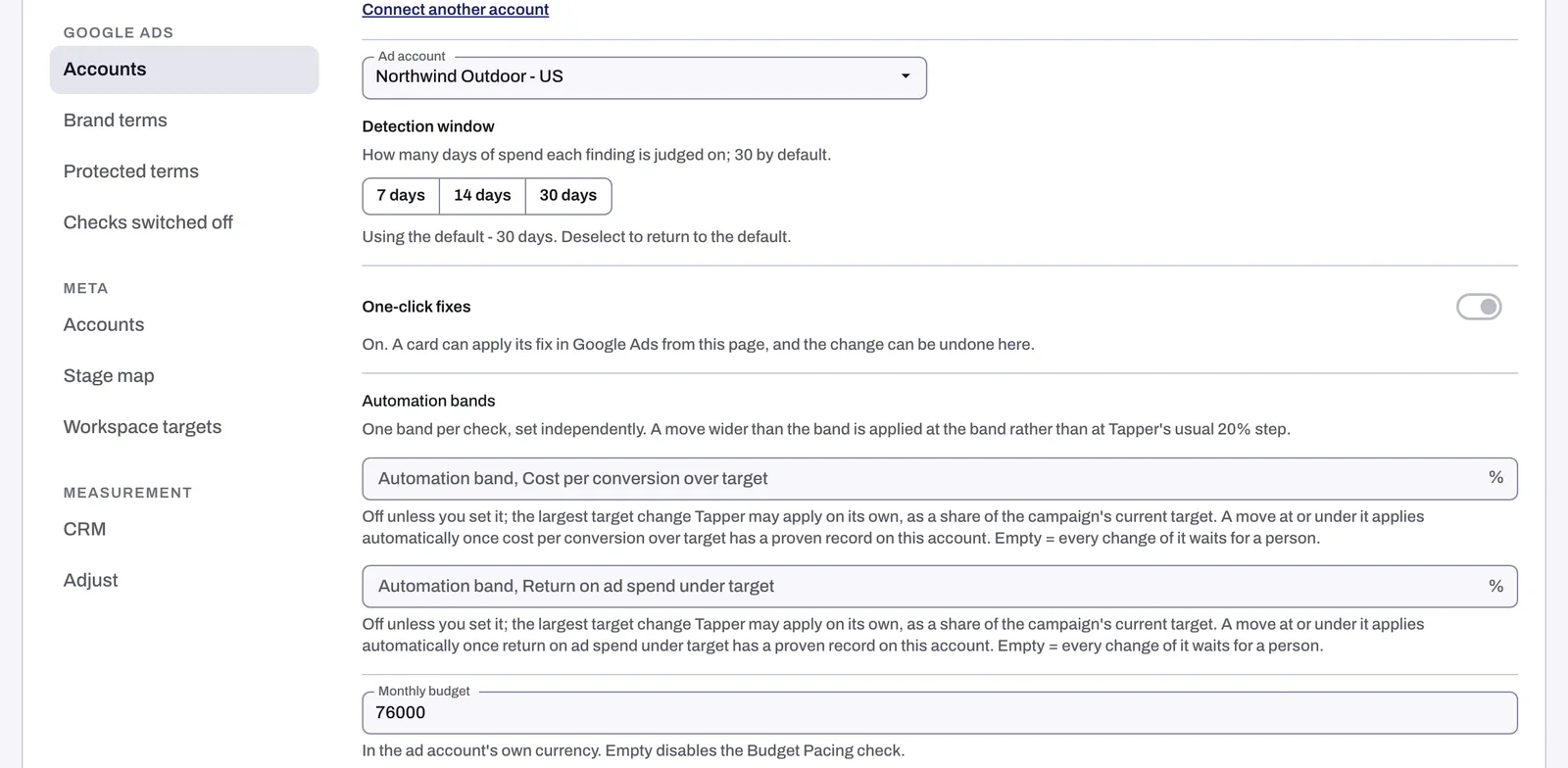
| Setting | What it changes |
|---|---|
| Detection window | Days of spend each finding is judged on: 7 days, 14 days or 30 days (default). Shorter reacts faster but sees fewer conversions, so fewer campaigns can be judged. A few checks keep their own windows. |
| One-click fixes | Shown only: whether a card can make its fix for you. If Turned off, ask your Tapper contact. |
| Automation bands | For Cost per conversion over target and Return on ad spend under target: the largest target change Tapper may make on its own, 1 to 50%. Empty (default) means every change waits for a person. See Automatic fixes and the Activity tab. |
| Monthly budget | What the account should spend a month, in its currency. Monthly budget off track flags a month heading more than 15% over or under; empty turns the check off. |
| Contribution margin | Roughly the share of an order left after product and delivery costs. Adds Margin on ad spend and Breakeven ROAS to ROAS cards. Lead generation accounts show Set a margin anyway. |
| Zero-conversion spend threshold | The spend at which a campaign with no conversions gets a card. Empty: worked out from the account's cost per conversion. |
| Ad testing | How much an ad must run before An ad losing its ad group's test judges it: Minimum impressions per ad (1,000) and Minimum days of data per ad (15 of the last 30; 0 turns it off). |
| After a target change | Days to wait before judging (21; 0 judges straight away): how long target, efficiency and low or no conversion cards wait after a target or bid strategy change. |
| Use ROAS for this account | On by default. Turn off when conversion value is an internal accounting figure: Lift judges on cost per conversion only, and open ROAS cards close without counting as fixed. |
| Conversions counted | The conversion actions Lift divides spend by; none ticked means Google's Conversions column. While any are ticked, the keyword, search term, ad, placement, channel and network checks do not run, and cost per conversion is judged per campaign. |
Brand terms
A campaign whose name contains a brand term (ignoring capitals) is a brand campaign: compared with your other brand campaigns, and money on a brand Search campaign's card is to check first, since it can be brand protection. Type plain words separated by commas and save. The block lists the brand campaigns and why; a term that matches almost every campaign is not used. With no terms, Lift guesses from the domain and name (Keep these keeps the guess), and a name marked Brand, or BRN or BRD on Search, counts anyway. Clear removes your terms. For one non-brand campaign, press Mark as not brand protection on its card.
Competitor names
Tapper keeps the competitor names your campaigns bid on: ask your Tapper contact to change them. A campaign is a competitor campaign when over half its 30-day keyword spend is on these names, or, with no keyword spend, when its name says competitor, competition, conquest or conquesting. Its cards say these usually cost more per conversion, and judge it only against other competitor campaigns.
Protected terms
Your core product terms: Lift never suggests excluding or pausing a keyword on one. The list is not shown: ask your Tapper contact to change it.
Checks switched off
Each check switched off on this account from a card (Dismiss, with a reason, then Not for this account), and who did it. Switch back on lets it raise cards from the next check. Meta checks are not listed: contact Tapper support.
Meta
Ad accounts lists your Meta ad accounts, with Connect Meta or Connect another account. The other tabs: Check the funnel stage Lift gives each Meta ad set, Set your Meta targets and Meta's recommendations and Lift's take. Nothing here changes your Meta account.
Measurement: data sources and Adjust
- Data sources lists the entity's connections, such as Salesforce, each linking to Setup > Data sources. Salesforce links your CRM, read-only, so Tapper can match each lead's outcome to its ad click. Lift's checks do not read it: they use the conversions your ad platforms report. See Connect Salesforce (read-only).
- Adjust: Lift compares Google's install count with Adjust's on Google Ads app campaigns matched to your app (Google and your Adjust count installs differently), reading campaign totals once a day and changing nothing in Adjust. Choose Or paste the API token of an Adjust user on your team, type the App token and API token, and press Check it: Lift checks the app at once and says why if it fails.
Related
Was this helpful?
Still need help?
Chat with our team and mention this article.