

Connect your data: Setup > Data sources
On this page
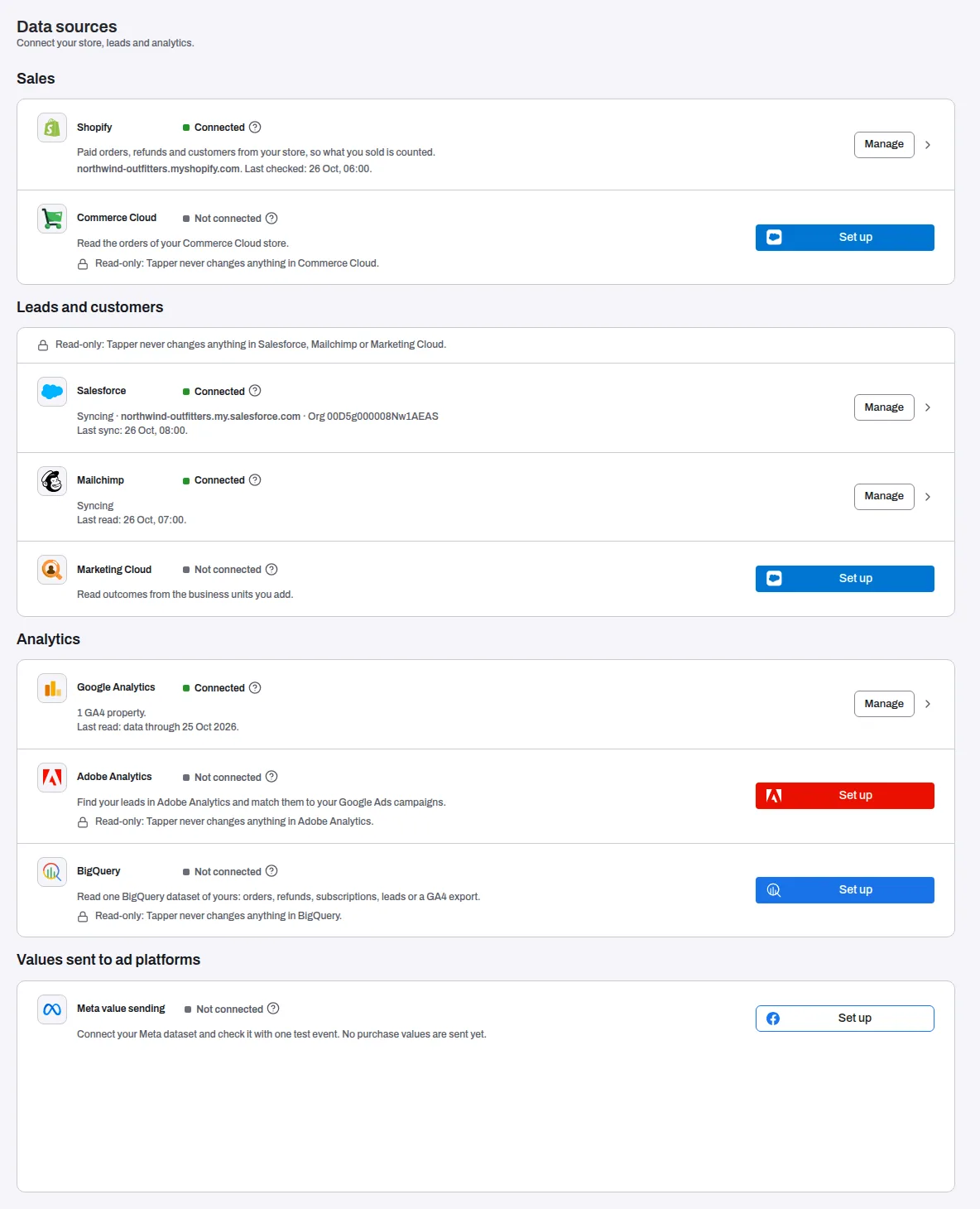
Setup > Data sources is where you connect the systems that hold your own results: your store, your leads and customers, and your analytics. Each protected entity has its own page, and Lift, Vantage and the goals link straight to the row they need.
Pick the entity in the switcher at the top of the sidebar, then click Data sources under Setup. The page reads "Connect your store, leads and analytics." and has four groups.
How a row works
- Status: Not connected, Connected or Needs reconnecting. A row your role cannot open reads Owners and admins.
- What you need: the ? next to the status says what to set up on the vendor's side first.
- The button: Continue with Shopify, Continue with Salesforce, Continue with Mailchimp and Continue with Google send you to the vendor to sign in and approve. Set up opens a form for keys you copy from the vendor. Manage, on a connected row, opens the source's page, with tabs such as Overview, Settings and Activity.
Most sources need the Owner or Admin role. Each source's article says who can connect it.
Sales
| Source | What it gives you |
|---|---|
| Shopify, one row per store | "Paid orders, refunds and customers from your store, so what you sold is counted." Lift compares your store's real orders with what Google and Meta report. Vantage can send each order's value to Google Ads on a goal Tapper switches on with you. See Install Tapper on a Shopify store. |
| Commerce Cloud | A store cannot be connected from this row, and no product reads Commerce Cloud data. See Salesforce Commerce Cloud on Data sources. |
Leads and customers
| Source | What it gives you |
|---|---|
| Salesforce | Vantage matches each lead's real outcome to the ad click behind it, so Google bids for revenue, not form fills. See Connect Salesforce (read-only). |
| Mailchimp | Contacts, customers and orders of the audiences and stores you choose, matched to your Shopify orders and ad clicks, so Vantage learns who comes back. See Connect Mailchimp. |
| Marketing Cloud | The business units you add, each checked with Test connection. See Connect Salesforce Marketing Cloud. |
Analytics
| Source | What it gives you |
|---|---|
| Google Analytics | Lift checks the purchases Google reports against your site's analytics. The dashboard gets a Google Analytics tab, and the Exclusions page shows Google Analytics proof for an excluded click. See Connect Google Analytics and read the Google Analytics tab. |
| Adobe Analytics | Your lead metric per tracking code, read daily and matched to your Google Ads campaigns. See Connect Adobe Analytics. |
| BigQuery | One dataset of yours, with Test listing the tables Tapper can see and a map of the tables it reads. See Connect BigQuery. |
Values sent to ad platforms
| Source | What it gives you |
|---|---|
| Meta value sending | Connects your own Meta dataset and checks it with one test event, in Test mode. No purchase values are sent. See Set up Meta value sending. |
The read-only promise
Every source in Sales, Leads and customers and Analytics is read-only: Tapper never changes anything in it. The Commerce Cloud, Adobe Analytics and BigQuery rows say "Read-only: Tapper never changes anything in ...", and the Leads and customers card says it once for Salesforce, Mailchimp and Marketing Cloud. Shopify and Google Analytics carry no such line, but are read-only too. Mailchimp's approval cannot be limited to reading, so Tapper's connection only ever reads.
Meta value sending is the one source Tapper writes to: your own Meta dataset, and only the test event you send.
Ad accounts connect on Setup > Ad accounts. A mobile app's tracking tool connects on Setup > Mobile app: see Connect a mobile app through your tracking tool.
Was this helpful?
Related articles
Still need help?
Chat with our team and mention this article.